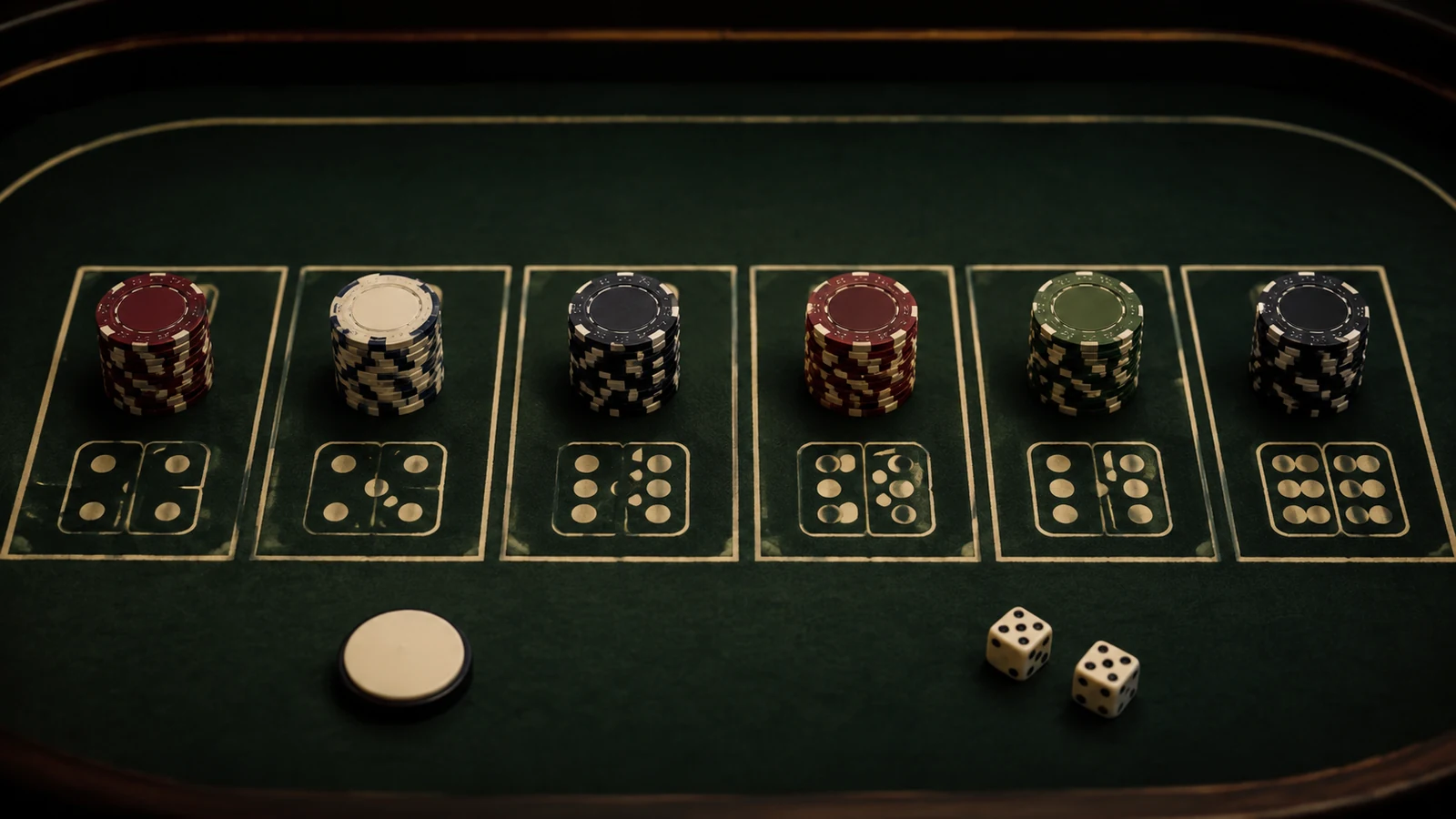
High-Limit Across Craps: Place Bets, Exposure, and Risk
Across Place bets · Scaled units · Total exposure · Table maximums
High-limit across betting covers 4, 5, 6, 8, 9, and 10 with Place or Buy bets at stakes large enough that payout rounding, commission timing, table maximums, and one seven-out materially affect the session. The dice math is the same as at a low-limit table; only the dollars move faster.
High limit is bankroll sizing, not a strategy edge
Large Place bets do not become more efficient because they produce large payouts. Scale the entire layout, calculate the loss on 7, and decide collection rules before putting chips into action.
A clean $640-across example
| Number | Place amount | Standard win | House edge |
|---|---|---|---|
| 4 | $100 | $180 | 6.67% |
| 5 | $100 | $140 | 4.00% |
| 6 | $120 | $140 | 1.52% |
| 8 | $120 | $140 | 1.52% |
| 9 | $100 | $140 | 4.00% |
| 10 | $100 | $180 | 6.67% |
| Total | $640 | 7 loses all six bets | Component edges differ |
The $640 amount keeps 6 and 8 in $6 units and the other numbers in $5 units. It is an illustration, not a recommended stake.
Expected cost while all six bets work
Using the standard Place payouts above, the combined one-roll expected loss is approximately $6.67 while the complete $640 layout is working:
- Place 4 and 10: about $1.67 expected loss per number per roll.
- Place 5 and 9: about $1.11 per number per roll.
- Place 6 and 8: about $0.56 per number per roll.
Dividing $6.67 by $640 gives about 1.04% of the complete layout per roll. That is a package calculation, not the conventional per-resolved-bet edge shown in the table.
Place or Buy the 4 and 10?
At $100, buying 4 and 10 often pays closer to true odds than placing them, but the exact advantage depends on whether the 5% commission is charged upfront or only on a win and how the casino rounds. A $100 Buy win at 2 to 1 produces $200 before commission; a $100 Place win produces $180. Ask for the quoted payoff rather than assuming one universal rule.
Collection, press, and regression choices
| Choice after a hit | Rack money | Next-roll exposure |
|---|---|---|
| Same bet and collect | Entire win is banked | Unchanged |
| Unit press | Part of win banked | Higher on one number |
| Power press | Little or none banked | Rises quickly |
| Regress | Returns part of the original stake | Lower across layout |
| All down | Returns all remaining stakes | Zero until re-entry |
High-limit checklist
- Confirm maximum bet and maximum payout; they are not always the same limit.
- Confirm whether 4/10 commissions are upfront or win-only.
- Say whether the point number is included.
- Confirm whether bets are working on the come-out.
- List line bets, Odds, commissions and dealer wagers separately, then include them in the complete layout and session-risk totals.
- Set a maximum total layout, not merely a maximum per number.
- Record money in the rack separately from chips still exposed.
Read the full Place-bet guide, Buy-bet commission guide, and table-limit guide. Standard payouts were checked against the Massachusetts Gaming Commission rules.
One hit, three choices, then a seven
Start with the $640 Across layout and suppose 6 rolls. The $120 Place 6 earns $140. If you collect the win and leave every bet unchanged, $140 enters the rack and $640 remains exposed. A 7 on the next roll removes the full layout, leaving $140 from the sequence. Relative to the original $640 supplied, the two-roll result is −$500.
If you instead use $120 of the win to press 6 from $120 to $240, only $20 reaches the rack and the layout grows to $760. A following 7 removes $760. The player finishes with $20 from the sequence, or −$620 against the original $640. The press used a payout rather than new cash, but those chips became owned money before they were put back at risk.
If you call all bets down after the winning 6, the crew returns the $640 of stakes and the $140 win. The result is +$140 with no next-roll exposure. These choices do not change what the first 6 paid. They determine how much of the resulting $780 in player-owned value sits safely in the rack and how much remains vulnerable to 7.
A win-only Buy commission changes both payment and cost
Suppose the crew accepts $100 Buy bets on 4 and 10 and charges exactly $5 only when either wins. Keep the other four stakes unchanged. The working principal remains $640. A 4 or 10 now pays $200 gross profit minus $5 commission, or $195 collected, rather than the Place payment of $180. A 7 still loses the $640 principal.
For each bought number, three dice combinations win $195 and six lose $100. The expected one-roll result is (3 × $195 − 6 × $100) ÷ 36, or about −$0.42. Replacing both Place 4/10 bets reduces this particular package’s expected loss from about $6.67 to $4.17 per working roll. This assumes the exact win-only fee, no rounding and the stated payouts; upfront collection requires different accounting. Ask the crew before sending chips, and use the Buy-bet comparison for other commission rules.