$22 Inside Regression: Rules, Payouts, and Probability
$22 Inside · Remove two winners · Rebuild · $2–$4 lock-in
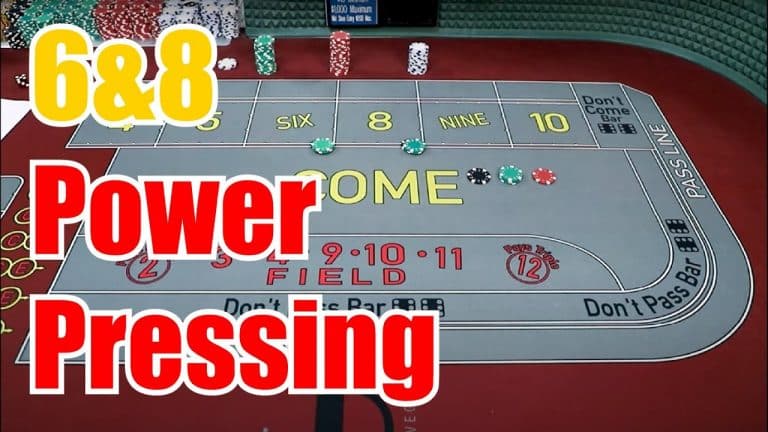
The $22 Inside regression starts with minimum Place bets on 5, 6, 8, and 9. The first two different numbers that hit are collected and removed; later hits rebuild those positions. Its strength is simple exposure reduction, not a promise that two hits will arrive before 7.
Two removed winners can lock $2 to $4
Every starting inside bet wins $7. Removing the winning stake returns another $5 or $6. After two different numbers hit, the rack contains $24 to $26 against the original $22, while two smaller positions remain working.
Starting layout and first-hit return
| Number | Place bet | Win | Win plus removed stake |
|---|---|---|---|
| 5 or 9 | $5 | $7 | $12 returned to rack |
| 6 or 8 | $6 | $7 | $13 returned to rack |
Step-by-step method
- Wait for a point if you do not want the Place bets working on the come-out.
- Place $5 each on 5 and 9 and $6 each on 6 and 8: $22 total.
- When the first number hits, collect $7 and remove that winning bet.
- When a different active number hits, collect $7 and remove it.
- Leave the other two inside bets working, or call them off according to the written exit rule.
- On each later active-number hit, use $5 or $6 of the $7 payout to restore one removed number. Do not press.
- After both positions are rebuilt, either repeat the reduction cycle or collect until 7.
Result after the first two different hits
| Removed winners | Cash returned | Still working | If 7 is next |
|---|---|---|---|
| 5 and 9 | $24 | $12 on 6/8 | +$2 cycle |
| One $5 number and one $6 number | $25 | $11 | +$3 cycle |
| 6 and 8 | $26 | $10 on 5/9 | +$4 cycle |
Those profits are locked only if the returned chips stay in the rack. Rebuilding puts part of the cash back at risk.
Follow one rebuild without double-counting stakes
Start with $5 on 5 and 9 and $6 on 6 and 8. If 5 pays first, collect its $7 profit and remove its $5 stake: $12 in the rack. If 6 pays next, collect $7 and remove $6: the rack reaches $25, while $6 on 8 and $5 on 9 remain working. A 7 now loses those $11 of Place bets, leaving a $3 gain against the original $22 layout.
If 8 hits instead, its $6 Place bet stays up and pays $7. Use $5 of that payout to restore Place 5 and rack $2; the rack is now $27 with $16 working. If 9 then hits, use $6 of its $7 profit to restore Place 6 and rack $1: $28 in the rack with all $22 back on the layout. A following working 7 loses that $22 layout, so the four-hit path finishes $6 ahead. Restoring a removed stake is a new exposure decision; the $5 and $6 cannot be counted as both racked and working.
Probability of reaching the reduction
At the start, 5, 6, 8, and 9 have 18 combinations and 7 has six. Ignoring neutral totals, the first inside hit arrives before 7 with probability 18/24, or 75%. After removing the winner, the remaining active combinations depend on which number hit. Combining those paths gives approximately a 51.84% chance of removing two different winners before 7.
That is close to a coin flip, not a near-certainty. A seven-out before any hit loses $22; one hit followed by 7 still leaves a loss of $9 or $10.
Why the second different winner is harder to reach
The 51.84% figure is not the chance of any two inside rolls. It is the chance of two paying hits on different active numbers before a working 7. Once a winner is removed, repeating it does nothing for this plan.
If 5 or 9 wins first, eight inside combinations were available to produce that first branch. Removing that number leaves 14 active combinations against six for 7. If 6 or 8 wins first, ten combinations produced that branch, and 13 active combinations remain. Therefore the complete success probability is (8/24 × 14/20) + (10/24 × 13/19) = 197/380, or 51.8421%.
For a concrete exit comparison, change the later rule to “take everything down immediately after the second different winner,” with no rebuilding. That exit earns $14 when reached: two $7 profits plus all original stakes returned. A 7 before either hit loses $22. A first 5/9 followed by 7 loses $10 overall; a first 6/8 followed by 7 loses $9.
Weighting all those branches gives −$81/190, about 43 cents expected loss per $22 entry. This calculation applies only to that specified take-down exit, not to the article’s optional rebuild. The successful path is slightly more likely than failure, but the sizes of the losses still leave negative expectation. Assumptions are standard Place payouts, independent fair dice, accepted $5/$6 units and all counted rolls working. See the Place rules before changing which numbers remain active.
Practical rules
- A repeat of a number already removed is not a collection unless you restored it.
- State whether the point number is included.
- Confirm correct $5 and $6 units at the table minimum.
- Keep the optional line bet outside this system’s accounting.
- Do not increase the next $22 entry because the prior hand failed.
Compare the larger $132 Inside regression and review the underlying Place-bet payouts.