Power Pressing 6 and 8: Valid Bets, Payouts, and Risk
Place 6 and 8 · Press ladders · Collections · Dollar risk
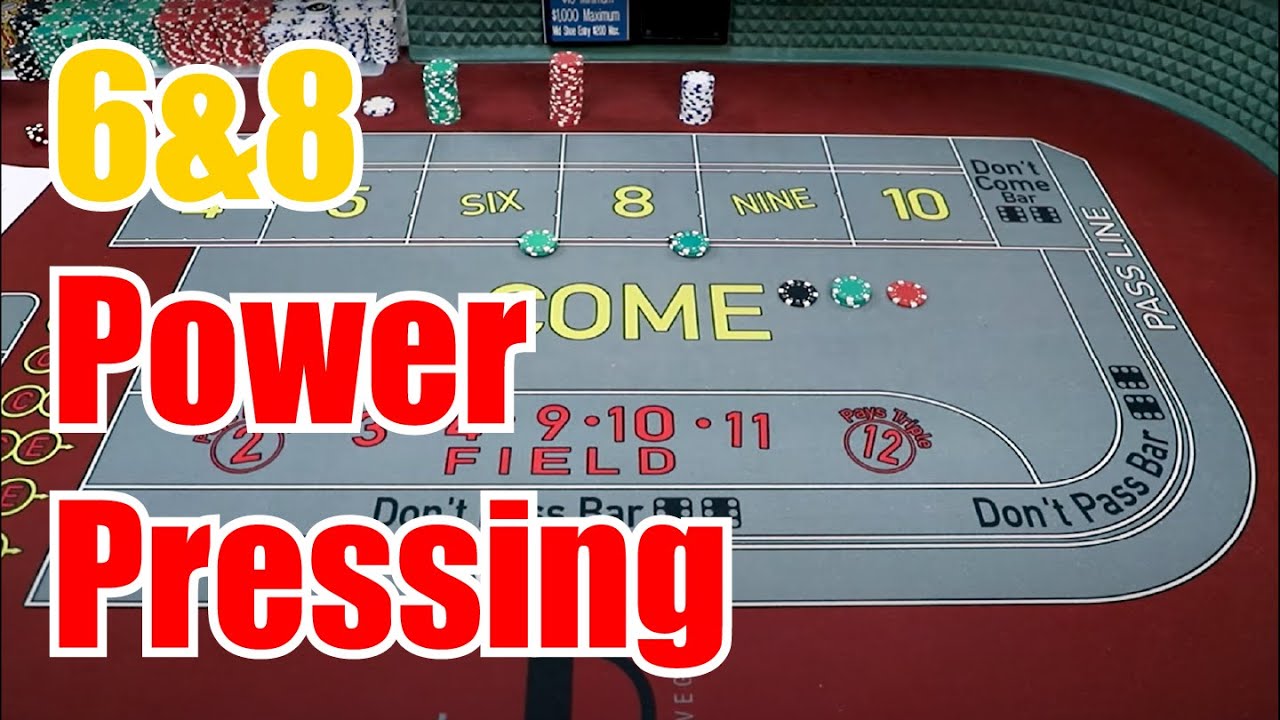
Power pressing 6 and 8 means using a Place-bet win plus additional chips to move the wager up faster than a normal unit press. The method can build a large payout during repeated hits, but the extra chips remain exposed and the 1.52% Place-bet edge does not change.
Pressing changes stakes, not the dice
Six and 8 each have five combinations; 7 has six. For one Place 6/8 decision, the number wins first with probability 5/11 and 7 wins first with probability 6/11, regardless of the previous roll.
Correct Place 6/8 units
Place 6 and 8 should normally be bet in multiples of $6 because the payout is $7 for every $6. At a $12 starting level, a resolved decision has:
(5/11 × $14) − (6/11 × $12) = −$2/11 ≈ −$0.1818
Dividing $0.1818 by the $12 stake gives the standard 1.515% house edge.
Three valid press styles
| Style after $12 wins $14 | New bet | Added or collected |
|---|---|---|
| Same bet | $12 | Collect $14 |
| One-unit press | $18 | Use $6; collect $8 |
| Power press | $30 | Use $14 win plus $4 additional cash |
Illustrative press-and-collect ladder
| Current bet | Win | Example next action | Cash collected |
|---|---|---|---|
| $12 | $14 | Press to $18 | $8 |
| $18 | $21 | Press to $30 | $9 |
| $30 | $35 | Collect; leave $30 | $35 |
| $30 next hit | $35 | Power press to $60 | $5 |
| $60 | $70 | Collect or use a written next step | $70 if collected |
This ladder is an illustration, not a mathematical optimum. Collecting earlier produces more rack money and slower growth; pressing harder produces larger possible future payouts and more money lost to 7.
Pressing both numbers
With $12 each on 6 and 8, $24 is working. If 6 hits and you use its payout to press both numbers, state exactly how the $14 is divided and keep both bets in $6 units. A vague instruction such as “press across” invites chip and payout errors at a busy table.
One hit can press both numbers, but little reaches the rack
Start with $12 Place 6 and $12 Place 8, or $24 working. If 6 hits, its $14 profit can add $6 to each wager, leaving $18 on 6 and $18 on 8. That uses $12 of the payout and puts only $2 in the rack. If the next working roll is 7, the $36 layout loses and the two-roll sequence ends $22 down against the original $24 outlay. Pressing only the winning 6 to $18 instead leaves $8 in the rack and $30 exposed, so the same 7 ends $16 down.
Both comparisons assume the Place bets are working when 7 rolls. After a point is made, Place bets are commonly off for the next come-out unless called on; confirm their status at that table before applying either seven-out result. The press choice changes the rack and exposure, not the probability of the next dice total.
“House money” and exotic bets
Some players move press profits to hardways or a three-win Hardways Bomb. Once paid, those chips belong to the player. Moving them to a 9.09% or 11.11% hardway adds a higher-cost wager; it does not protect the Place bets or preserve bankroll.
Choose the collection rule before the hit. “I will collect every third hit on each number” is trackable. “I will press while the table is hot” depends on a feeling that cannot predict the next roll.
Compare the more aggressive Triple Lux, the regression-based Squeeze Play, and the full Place-bet guide.
One hit followed by 7: rack versus layout
Start with $12 each on 6 and 8, so $24 is working. If 6 hits, the $14 profit can press that wager from $12 to $18 by returning $6 to the layout; $8 reaches the rack and $30 is now working. If the next roll is 7, the $30 layout loses. Relative to the original $24, the completed sequence finishes down $16 because only $8 was collected.
Collecting the full $14 instead would leave $24 working and make the same next-roll 7 finish the sequence down $10. Neither choice changes the dice. The comparison shows exactly what the faster press buys: $6 more exposure and $6 less protected rack money at that checkpoint.