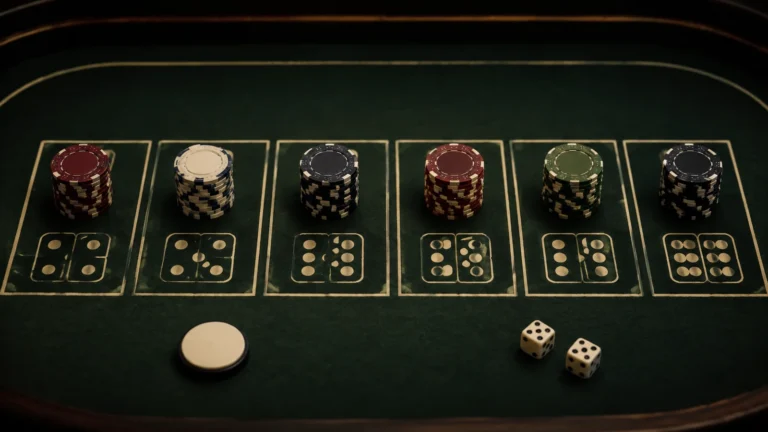
$22 Inside on the Come-Out Roll: The Lou Progression
Contributor system · Working come-out bets · Progression risk · Rule ambiguity
Lou’s “$22 Inside on the Come-Out” system starts with $5 Place bets on 5 and 9 and $6 Place bets on 6 and 8. It seeks two collections before taking bets down, but its original doubling instructions are incomplete. Here is the playable part, the unresolved part, and the risk the short version hid.
The short verdict
The base layout is easy to understand. The loss progression is not a recovery guarantee and can become large quickly. Do not use the progression until “half double” and the exact removal sequence are written as dollar amounts.
The opening $22 Inside layout
| Number | Place bet | Winning payout |
|---|---|---|
| 5 | $5 | $7 |
| 6 | $6 | $7 |
| 8 | $6 | $7 |
| 9 | $5 | $7 |
| Total | $22 | One inside hit collects $7 |
The page specifically calls for the bets to work on the come-out roll. Tell the dealer “working” before the dice are out and confirm the lammer or dealer acknowledgment. Place bets are commonly off on the come-out unless called on. A come-out 7 therefore loses all $22 when the bets are working.
What the original sequence appears to mean
- Start $22 Inside and working.
- After the first inside hit, collect $7 and leave the layout.
- After the second inside hit, remove one paired bet: a hit on 6 corresponds to removing 5, and a hit on 8 corresponds to removing 9. The original note does not say what to do after a second hit on 5 or 9.
- After the next collection, take every remaining bet down.
- After a losing 7, raise the next layout according to the progression.
That is the most defensible reading, not a complete rule set. A system that leaves the 5/9 cases undefined invites improvised decisions under pressure. Write those cases down before risking money.
The probability and expected cost
On any roll there are 18 combinations for 5, 6, 8, or 9 and six combinations for 7. Ignoring the 12 neutral combinations that resolve neither side, the chance of an inside number arriving before 7 is 18/24, or 75%. The chance of two inside collections before 7 is 0.75 × 0.75, or 56.25%. That does not measure the page’s final exit because the removal rule is incomplete.
Across all 36 combinations, the $22 layout has an expected loss of about $0.17 per working roll: 18 winning combinations each collect $7, while six sevens lose $22. Turning the bets off changes how often money is exposed; it does not improve the edge while they are working.
Why the progression needs a hard cap
| Level | Inside layout | Total risk through that level |
|---|---|---|
| 1 | $22 | $22 |
| 2 | $44 | $66 |
| 3 | $88 | $154 |
| 4 | $176 | $330 |
| 5 | $352 | $682 |
| 6 | $704 | $1,386 |
A doubled $44 layout collects only $14 on one hit, so one collection does not recover the prior $22 loss. The phrase “half double” is also mathematically ambiguous: it could mean add half the prior stake, increase to one-and-a-half times the stake, or recover half the loss. Those are different systems.
Use a fixed loss limit, not the old suggestion that a $5,000–$10,000 bankroll makes the method safe. A larger bankroll permits more escalation; it does not change the dice or remove the house edge.
Compare the fully specified $22 Inside regression-and-rebuild system, the Place bet guide, and our craps systems audit framework.
Resolve the undefined second-hit branch before play
Suppose the first hit is 6 and the second hit is 5. The stated pair rule removes 5 after a hit on 6, but 5 has just paid and would ordinarily still carry its original $5 Place chip. A player must decide whether that instruction means remove the paid $5, remove the opposite 9, or leave all four numbers until another trigger. Those choices create different exposure.
One transparent player-defined completion is: after the second inside hit, remove the opposite number in the same low/high pair—5 after 6, 6 after 5, 9 after 8, or 8 after 9. Then collect one more inside payout and call every remaining Place bet down. This makes all four second-hit numbers actionable without claiming the completion came from the original contributor.
Write the chosen mapping beside the loss-progression rule before buying in. After every hit, record the payout collected, the stake removed, and the amount still working. If a branch cannot be stated in dollars before the dice move, stop at the basic $22 layout rather than improvise a larger wager under pressure.