$20 Horn Bet Payout: What You Win When 12 Rolls
Horn payout · $20 example · 12 rolls
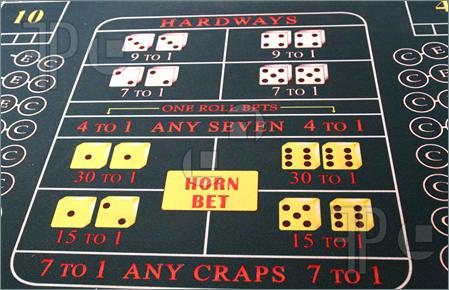
On a standard $20 Horn bet, $5 is placed on each of 2, 3, 11, and 12. If 12 rolls and the table pays 30 to 1, the winning $5 component earns $150 while the other three $5 components lose. Net profit: $135. Total chips returned: $155.
The answer in one table
| Total Horn wager | $20 |
|---|---|
| Amount on 12 | $5 |
| Profit on 12 at 30 to 1 | $150 |
| Loss on 2, 3, and 11 | −$15 |
| Net profit | $135 |
| Total returned including the winning $5 stake | $155 |
Why three parts lose
The Horn is not one wager with one payout. It is four simultaneous one-roll bets:
| Horn number | Share of a $20 Horn | Standard payout | Result when 12 rolls |
|---|---|---|---|
| 2 | $5 | 30 to 1 | Loses $5 |
| 3 | $5 | 15 to 1 | Loses $5 |
| 11 | $5 | 15 to 1 | Loses $5 |
| 12 | $5 | 30 to 1 | Wins $150 profit; $5 stake returned |
That is why subtracting the full $20 from $150 is wrong: the $150 figure is already profit on the winning $5 component. Only the other $15 loses. $150 minus $15 equals $135 net profit.
Profit versus total return
Casino payoffs are easy to misread because 30 to 1 describes profit, while 31 for 1 describes the total returned including the winning stake. On the $5 bet on 12:
- 30 to 1: $5 × 30 = $150 profit, plus the $5 stake;
- 31 for 1: $5 × 31 = $155 total return.
Both expressions describe the same standard payoff. Check the layout because some tables use different proposition paytables.
What if 3 or 11 rolls?
A $5 component on 3 or 11 wins $75 profit at 15 to 1. The other three $5 bets lose $15, producing $60 net profit and $80 total chips returned.
| Winning Horn result | Net profit on $20 Horn | Total returned |
|---|---|---|
| 2 or 12 at 30 to 1 | $135 | $155 |
| 3 or 11 at 15 to 1 | $60 | $80 |
| Any other total | −$20 | $0 |
Why the standard Horn edge is 12.5%
There are six winning combinations: one way each to roll 2 and 12, plus two ways each to roll 3 and 11. Thirty of the 36 combinations lose all four units. On a four-unit Horn:
[(2 × 27) + (4 × 12) − (30 × 4)] ÷ 36 = −0.5 unit
The expected loss is 0.5 unit on 4 units wagered, or 12.5%. A recent run of Horn numbers does not improve the next roll’s probability.
Use multiples of four. A standard Horn divides equally among four numbers. A non-multiple requires a Horn High instruction or a house-specific split.
See the full Horn and Whirl guide for Horn High, Whirl, payout variations, and house edges.
Why “same bet” changes the chips you collect
After the $20 Horn wins on 12, the settled components produce $155 total: $150 profit on the winning component plus its $5 stake. You can collect all $155, or use $20 of it to construct another equal Horn. If you repeat, only $135 reaches the rack and $20 is newly exposed. The first roll’s $135 net profit is unchanged; the collection differs because you bought another wager.
| Instruction | Chips collected | Next Horn at risk |
|---|---|---|
| Everything down | $155 | $0 |
| Same $20 Horn | $135 | $20 |
Start with $200 to check the complete sequence. Placing the first Horn leaves $180 in the rack. After 12, repeating gives a $315 rack plus $20 exposed, or $335 combined. If the next roll is 6, that repeated Horn loses, leaving $315: a $115 session gain, equal to the first $135 win minus the next $20 loss.
Taking everything down after the first win instead leaves $335 with no Horn exposed. Tell the crew which instruction you want and inspect the renewed split before the dice move. A payment of $135 beside a repeated $20 layout is consistent with the $155 full return; those figures describe different destinations for the same settled chips. The Horn and Whirl guide explains how a named high component changes that split.
Turn the 12.5% edge into a dollar expectation
With $20 divided into four $5 components, the standard 12.5% Horn edge means an average loss of $2.50 per $20 wager over many independent rolls. It is not a $2.50 fee taken each time: most rolls lose all $20, a 3 or 11 produces $60 net profit, and a 2 or 12 produces $135 net profit under the stated paytable. The uneven outcomes average to a loss.
For ten identical $20 Horn bets, the mathematical expected loss is $25, but the actual result could be much higher or lower. Compare that expected cost with a standard low-edge bet using the same total amount risked. Do not compare the $135 rare win with only one $5 Horn component while ignoring the other $15 exposed on the same throw.
Check a Horn bet with a separate extra chip
If you put $20 on a standard Horn and separately place $2 straight up on 12, account for both bets when 12 rolls. The Horn returns $155 in total and earns $135 net across its four parts. At 30 to 1, the separate $2 bet earns $60 and returns $62. Together they return $217 from $22 staked, for $195 net profit. Confirm that the dealer accepted a separate 12 wager. A Horn High 12 is a different allocation of chips.