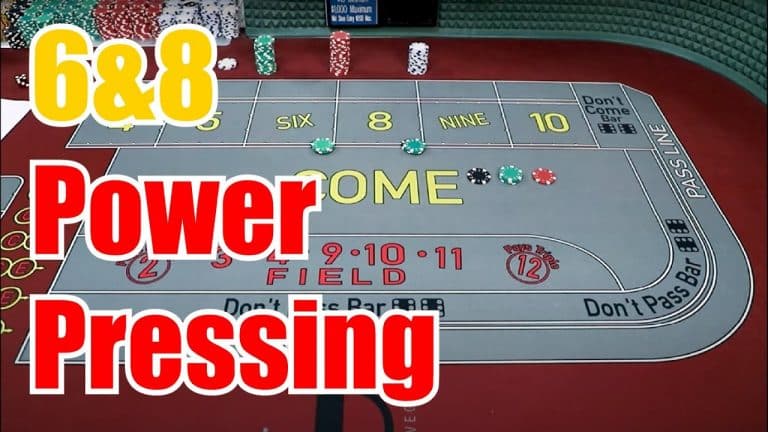
6 and 8 Regression With 4/10: Correct Cash Flow
$18 each on 6/8 · Regress · Add 4/10 · Valid press ladders
This contributor strategy begins with $18 each on 6 and 8, regresses both after one hit, then uses a second hit to add 4 and 10. The original cash flow is sound through the second hit: it reaches a $1 locked gain with $34 working, provided both hits occur before 7.
Two 6/8 hits before 7 occur 39.06% of the time
Six and 8 have ten combined combinations and 7 has six. Ignoring neutral totals, one 6/8 hit arrives before 7 with probability 10/16; requiring two hits gives (10/16)² = 39.06%.
Opening and regression cash flow
| Stage | Action | Cash in rack | Working | Net if 7 follows |
|---|---|---|---|---|
| Start | $18 each on 6 and 8 | $0 | $36 | −$36 |
| First hit pays $21 | Regress both to $12; return $12 | $33 | $24 | −$3 |
| Second hit pays $14 | Add $5 each on 4 and 10; collect $4 | $37 | $34 | +$1 |
The first regression returns the $21 win plus $12 removed from 6/8, or $33 against the original $36. The second hit uses $10 of its $14 payout to establish 4 and 10 and banks $4, taking total rack money to $37.
What happens when 4 or 10 hits
A $5 Place 4 or 10 wins $9. The contributor proposed adding $1 to move both numbers from $5 to $10: the $10 combined increase uses the $9 win plus $1 from the rack. That leaves $36 in the rack and raises the working layout from $34 to $44—break-even cash with $44 exposed.
The old article also called the 4/10 positions Buy bets. At $5, many tables instead book them as Place bets because commission minimums and rounding can erase the Buy advantage. Ask when Buy bets are accepted and whether commission is charged upfront or on a win.
Contributor press ladders
| Numbers | Original ladder | Unit check |
|---|---|---|
| 6/8 | $12 → $24 → $30 → $42 → $66 → $90 → $150 → $240 → $360 → $600 | All multiples of $6 |
| 5/9 | $5 → $10 → $25 → $35 → $60 → $75 → $125 → $200 → $300 → $500 | All multiples of $5 |
| 4/10 | $5 → $10 → $25 → $50 → $100 → $200 → $300 → $500 | Valid $5 units; Buy rules vary |
The ladder gives permitted target amounts, not instructions for funding each jump. At every hit, write how much comes from the payout, how much additional cash is required, and how much is collected. “Same bet” should always remain an option.
Corrections to the original claims
- Ten ways to roll 6 or 8 versus six ways to roll 7 gives 62.5% for the next relevant result—not certainty.
- Two required hits reduce the probability to 39.06%.
- “Recouped investment” is true only after the second hit and only while returned chips stay in the rack.
- Expanding to 5 and 9 adds coverage and exposure; it does not use costless house money.
- Recent rolls do not identify a better time to press.
Compare power pressing 6 and 8, the $132 Inside regression, and the underlying Place-bet payouts.