
$44 Inside Craps System: Full $124 Exposure Explained
$44 Inside · Lay 4 and 10 · $124 opening exposure · Hedge cost
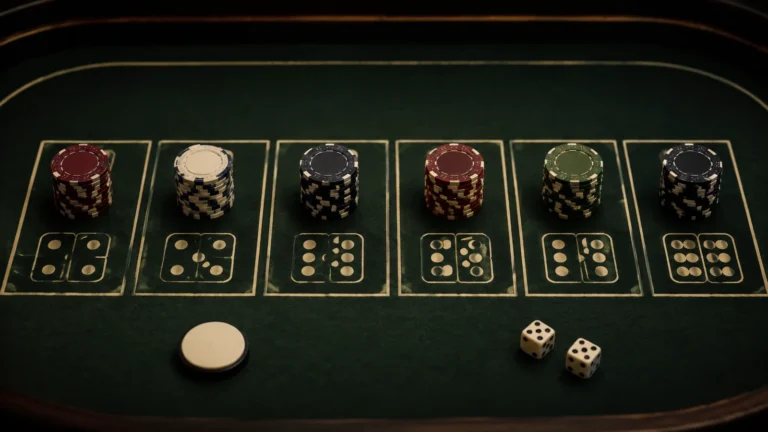
The 44 Inside system combines $44 of inside Place bets with $40 Lay bets against both 4 and 10. The name describes only the inside portion: the complete opening layout risks $124 before commissions.
This is a three-part hedge, not a $44 system
The Place bets want 5, 6, 8, or 9 before 7. The Lay bets want 7 before 4 or 10. Those positions can offset part of one another, but commissions and uncovered sequences prevent a guaranteed profit.
Opening layout
| Position | Risked | Standard win before commission |
|---|---|---|
| Place 5 | $10 | $14 |
| Place 6 | $12 | $14 |
| Place 8 | $12 | $14 |
| Place 9 | $10 | $14 |
| Lay 4 | $40 to win $20 | $20 less commission |
| Lay 10 | $40 to win $20 | $20 less commission |
| Total | $124 | Depends on the roll sequence |
A casino may charge the Lay commission upfront or only on a win, may round it, and may require different minimums. Confirm the exact price before using the example.
The contributor’s reduction rule
- Start with all six positions above after confirming which bets work on the come-out.
- When any inside number hits, collect its $14 win.
- Remove both Place 5 and Place 9, returning $20 to the rack.
- Leave $12 each on 6 and 8 and both $40 Lay bets working.
- Decide beforehand whether the next 7 ends the cycle or whether another roll changes the layout.
A favorable two-event sequence
Assume win-only $1 commissions on each $40 Lay bet. An inside hit returns a $14 win plus the removed $20 from 5 and 9. If 7 is the next relevant result, the two Lay bets win $38 combined after commission and return their $80 principal; the $24 on 6 and 8 loses.
| Cash-flow item | Amount |
|---|---|
| Opening amount placed | −$124 |
| Inside win plus removed 5/9 stakes | +$34 |
| Lay principal returned plus net Lay wins on 7 | +$118 |
| Cycle result | +$28 |
That is the sequence the system is trying to create. It is not the only sequence. A 4 or 10 can remove a $40 Lay position before 7, repeated inside hits may arrive, and come-out working rules can change which bets are exposed.
If 4 removes one Lay bet before the inside win
Keep the same $124 opening layout and assume the $1 commission is charged only when a Lay bet wins. If 4 rolls first, Lay 4 loses its $40 stake; no inside Place bet pays. An inside hit later pays $14, and removing Place 5 and 9 returns $20. The rack holds $34 while $24 on 6/8 and the $40 Lay 10 are still on the table.
If 7 is the next relevant roll, Place 6/8 loses $24. Lay 10 wins $20 less its $1 commission and returns its $40 stake, or $59 to the rack. The cycle returns $34 + $59 = $93 against $124 initially placed: a $31 loss. The earlier favorable sequence made $28, but losing one Lay position first reverses the outcome. An upfront commission, a different rounding rule, or bets called off on a come-out changes the exact cash flow; use the table’s rules rather than assuming this sequence is guaranteed.
A first-roll 7 still loses money on the complete layout
Keep the example’s win-only $1 commission on each $40 Lay wager, all six opening positions working and no additional bets. If 7 arrives before any inside collection, both Lay bets win $20 before commission and both $40 stakes return. That is $118 collected. All $44 of Place bets lose, so the $124 opening layout finishes $6 down, not even.
The Lay profits supply $38 after commissions, which is $6 short of the $44 lost inside. To compare cash rather than gross wins, begin with $200: placing $124 leaves $76 in the rack; collecting $118 after 7 leaves $194. This assumes the bets are taken down after the decision, with no renewed Lay wagers.
There is a more severe unprotected path. If 4 and 10 both arrive before any inside win, each $40 Lay bet loses. The remaining $44 inside is still exposed. A later working 7 loses it too, leaving the full $124 loss. Under this win-only commission example, none of those losing Lay bets adds a commission; upfront charging would make the outlay larger.
These paths do not invalidate the earlier favorable sequence; they show why the whole package has no guaranteed floor. Before a come-out, confirm each wager’s working status separately. Place bets and Lay bets need not share the same default. Review Lay commission and settlement rules and use the crew’s accepted instructions rather than treating six chips as one indivisible bet.
What can go wrong
- The title understates opening exposure by $80.
- A 4 or 10 before 7 loses the corresponding $40 Lay bet.
- Every Lay win pays a commission under the table’s stated policy.
- Place 5/9 and Place 6/8 still carry their normal house edges.
- Calling the layout a “choppy-table” strategy does not predict the next roll.
Read the complete Place-bet guide and Lay-bet commission examples before combining them.


I use a system similar to this and it is true, if the dice don’t roll your way it can get treacherous. I put $80 each on No-4 and No-10, $10 place bet on the 5 and 9, $24 place bets on the 6 and 8. If at any time a 4 or 10 rolls I re-up the bet. If 6 or 8 hit I take them down or turn them OFF, let the 5 and 9 hit a second time before taking down or turning OFF. Sometimes I increase my payout by adding a $10 Don’t Pass Bar bet and if I’m really feeling froggy, when my 5 or 9 hit I’ll push the bet to $20 and take it down on the next hit. I have had good success at the casinos with this method and it doesn’t matter which way the table is rolling but you have to stay with it, I’ve gotten a lineup of 4, 6, 10, 4, 4, 5, 10 and it is devastating to the chip stack but it always comes back with even bigger payout. I started this method on Sun Palace with $1000 (play money since I haven’t set up real money) and have turned it into $19k. Craps Trainer Pro on my phone has resulted in $1000 turning into $32k with the same strategy. I never use this strategy unless I’m walking up to the table with at least $500
Hello NavEOD, This is awesome! Keep testing some more and then try some with real money. Playing online gives you the advantage of using an app like craps trainer pro ! Good luck at the tables and have a wonderful holiday season!
Editorial clarification, September 5, 2026: The reply above is historical. A few profitable simulator sessions do not establish a player advantage, guarantee recovery after losses, or justify moving to real-money play. Practice can teach rules and payouts, but standard wagers retain their house edge and the combined layout can suffer substantial losses. Read the current article’s full exposure and commission example before evaluating this method. The old app and operator references are not current recommendations.