
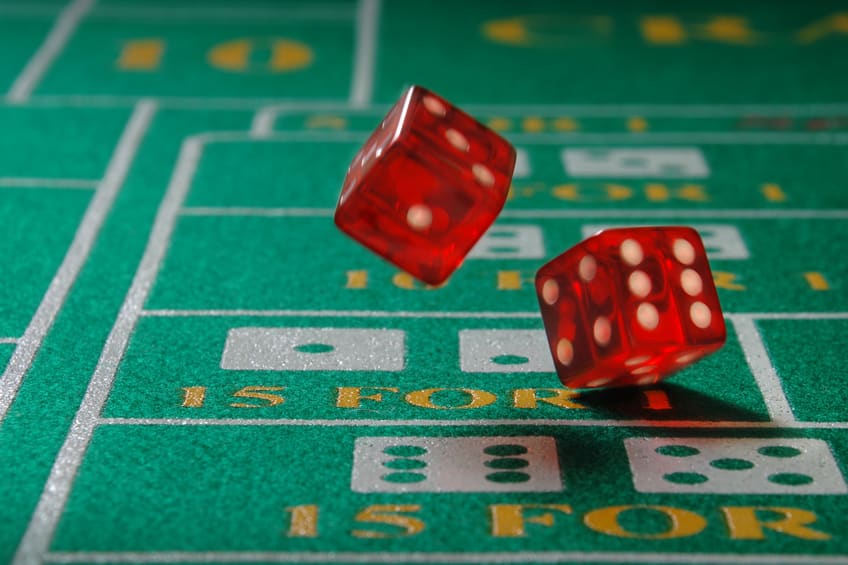
Staged Place-Bet Expansion: Can It Minimize Craps Losses?
Staged expansion · Pass with Odds · Place bets · Collect and press
This staged system begins with Pass Line, affordable Odds, and one or two Place bets. It uses later collections to cover more numbers, then alternates collecting and pressing. It can limit the opening layout compared with betting Across immediately, but it cannot guarantee smaller losses or that one future hot roll will repay earlier sessions.
What the method actually accomplishes
The method delays broad exposure until the shooter has already produced paying numbers. That is a valid cash-flow preference. It does not identify a hot roll in advance, and every added Place or Buy bet creates another negative-expectation position.
The seven-stage rule set
- Start: Make one Pass Line bet and add only an affordable amount of true Odds after a point.
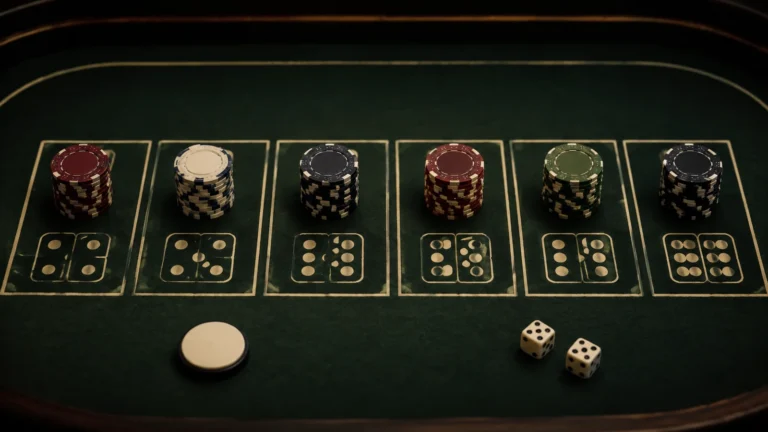
- Add 6/8: If the point is 4, 5, 9, or 10, Place both 6 and 8. If the point is 6, Place only 8; if point 8, Place only 6.
- Collect first: Bank the first Place-bet payout without pressing or adding a number.
- Build Inside: Use selected later Place payouts to add uncovered 5, 6, 8, or 9, avoiding a duplicate Place bet on the Pass point.
- Collect again: After all four Inside numbers are covered by Pass and/or Place, bank the next Place payout.
- Expand outside: Use later payouts to add 4 and 10. Compare Buy treatment when the stake and commission make it cheaper.
- Press mode: Once all box numbers are covered, alternate collecting and pressing each winning number under a fixed ceiling.
Handling a new point
Place bets normally remain on the layout after a point is made and are commonly off for the next come-out. When a new point duplicates a Place number, move that Place bet to an uncovered number or remove it; adjust 6/8 amounts to multiples of $6 and 5/9 amounts to multiples of $5. The flat Pass bet and Place bet are different contracts, so leaving both on the same number creates intentional double exposure.
Coverage is not probability of profit
All six box numbers account for 24 of 36 combinations, while 7 has six combinations and horn totals have six. Saying “24 ways to hit” sounds powerful, but a 7 can remove every working Place/Buy bet at once. A basic $32 Place-Across layout has about $0.33 expected loss per working roll under common payouts. More coverage increases hit frequency and total exposure together.
Opening exposure
| Point | Example opening after point | Total working amount |
|---|---|---|
| 4 or 10 | $5 Pass + $5 Odds + $6 Place 6 + $6 Place 8 | $22 |
| 5 or 9 | $5 Pass + $6 Odds + $6 Place 6 + $6 Place 8 | $23 |
| 6 or 8 | $5 Pass + $5 Odds + $6 on the other sister number | $16 |
Four ordinary losing games can consume a $100 buy-in; calling that “unlikely” without defining each complete path is not useful. Size the opening from the maximum acceptable first-decision loss, not from a hope of lasting a certain number of shooters.
Press mode needs a ceiling
- Set a maximum on each number and for the total layout.
- Keep Buy/Lay commission rules in the cash-flow calculation.
- Bank the first large payout even if the alternating schedule says press.
- Do not increase Pass Odds merely because Place bets have grown.
- After 7, reset only if the session loss limit still allows another opening layout.
Compare the progressive betting schedules, Place bet rules, and session limits.




When you finally get to “Press” mode, do you always double the bet? (i.e. $30 on 8, the 8 hits, you win $36 and you press to $60?)
Hi Brendan.
By the time you get to Press mode, things have gotten really exciting and emotions can easily take over. The answer to your question depends on your comfort level and the size of your remaining chip stack. Some people like to strictly follow the rules and alternate no matter what: press, take profit, press, take profit, etc. Others are more cautious and afraid to lose all the money they have on the table, which is quite a lot to some people. Some people find a happy median somewhere in between.
Here’s what I usually do. Suppose my Place bets look like: 4=$25, 5=$10, 6=$24, 8=$12, 9=$20, and 10=$10. If the next roll hits a low bet (e.g., the $10 Place 5), then I usually press it to $20. Now, for this example, suppose my chip stack is low and almost gone. In this case, my immediate goal is to hope like heck I hit a big bet to build up my chip stack so even if the dreaded 7 hits two rolls later, I’ve bumped up my chip stack to keep me going at the table for another hour. So, with a low chip stack, if one of my big bets hits, such as my $25 Place 4 and I win $50 minus the vig, then I’ll take the profit again even if it’s time to press. In this case, I’ve instantly bumped up my chip stack by $50 minus the vig. Sometimes, I’m in the mood to take profit again if the 4 hits again on the very next roll instead of pressing it. When taking profit like this two or three times in a row (instead of pressing in between wins) on a big bet like the $25 Place 4, I instantly build up my chip stack from the brink of disaster all the way back up to my $100 buy-in amount. In cases where my chip stack is really big, such as when I’m $150 ahead, then I’m more inclined to alternate no matter what happens.
Once I get several hundred dollars ahead, I usually always alternate and don’t worry about needing to build up my chip stack. When it gets to that point, I’m greedy and want to press everything to black chips. So, again, it all boils down to your comfort level and your chip stack. Good luck and have fun at the tables!
In these examples the place/buy bets get out of sync with one another because the number that just won is always the one thats being pressed or bumped. Is there a reason that you dont spread it around to the other numbers to bring them all up?
Hi LittleJoe,
Thanks for your comment, and that’s a great question. Actually, I sometimes do that, but not very often. Depends on the mood I’m in and how the dice are falling.
Usually when I press, I press the number that hits, regardless of how unbalanced the bet amounts might be across the layout. I haven’t charted the results for proof, but I believe that when the table heats up and I get to press mode, my bet amounts are always unbalanced. I can’t remember a single time when my bet amounts were balanced across the layout. At least one number has always been pressed up a lot higher than the others.
My explanation for this phenomenon is simply that trends occur and, as a result, some numbers hit more than others during the hot roll’s short time period (i.e., “short time” in terms of the one or two hours in which the hot roll occurs out of the thousands of hours of craps playing time that a table gets per year).
For example, suppose the 6 and 9 are pressed up to $180 each, and the other numbers are stuck at $12 or $10. What does this tell us? Very simply, it tells us that a trend is occurring where the 6 and 9 are hitting more often than the odds say they should. This is normal because trends in either direction (hot and cold) occur routinely. In this example, the trend happens to be where they hit a lot (as opposed to never hitting). So, if the bet amounts across the layout clearly tell us that the 6 and 9 are trending hot by virtue of having $180 on them instead of the measly $12 or $10 that are on the other numbers, then why go against the trend for the sake of spreading out your winnings across all the numbers? Why not take advantage of the obvious trend and get those hot numbers higher? Yes, dice outcomes are random in a legal game with legal dice, but it’s a statistical fact that short-term trends do occur.
No one can predict when a trend (either hot or cold) will end or reverse, so our best hope is to ride it out as long as we can. The dice will tell us when they decide to change trends. For example, the 6 and 9 stop hitting, and the 8 hits every other roll. In this example, I hope to take advantage of the new hot trend on the 8 so I press it up, up, and away. If the 6 and 9 haven’t hit in what seems like an eternity, I might reduce the bet amounts on them and pile it onto the numbers that seem to be heating up. It’s all a gut feeling and a guessing game. The trick is to guess right more often than you guess wrong. In my experience, I’ve found that the only way to accomplish that is to learn to recognize trends (which do occur as a statistical fact) and try to take advantage of them.
Good luck at the tables!
Editorial clarification — September 7, 2026: The reply above describes personal play from 2015. A table does not ‘heat up’ in a predictive sense: fair rolls are independent, and recent outcomes do not change the next roll’s probabilities. Pressing after a streak changes the dollars exposed, not the house edge or chance of the next total. The original reply is preserved for context.
Hi. I really have enjoyed reading all the articles on your site. After having just read this one I have a question. Do you ever play with Come bets rather than pressing and bumping place/buy bets? I tend to play that way, using both Come bets and Place bets, using the Place bet winners to fund the odds on my come bets. I just wonder if one way is better or worse in terms of house advantage and payouts.
Thanks for all the great info!
Hi gtoddh, thanks for your post.
As you know, Come bets are just like Pass Line bets in terms of having a relatively low house advantage; therefore, Come bets are a smart, solid way to play. Also, as you know from our material on hedge bets, there’s no combination of bets or bet amounts that will reduce the house advantage (don’t ever let anyone convince you otherwise). In fact, the more bets you make, regardless of any hedge system you might use, the better for the casino. So, to answer your question whether your way or my way is better or worse in terms of house advantage, the answer depends on how many Come and Place bets (and which numbers are Place betted) that you’d make on average versus how many Place/Buy bets (and which numbers are Place/Buy betted) that you’d make on average. Obviously, if you make any number of Place bets versus the same number of Come bets, the casino is better off because the house advantage is greater with Place bets. It’s more complicated when comparing the overall house advantages for two different sets of multiple bet types (e.g., four Come bets and two Place bets on the 4 and 10 versus a Pass Line bet and four Place bets on the 5, 6, 8, and 9). I’ll leave it up to you to figure out the house advantages for whatever combinations you want (see our other article for a basic tutorial on calculating house advantage). As described in our articles, I play for the fun and excitement of the game (I don’t play to try to get rich or to make enough money to buy a new car).
Over my long craps-playing life, I’ve found the system that gives me the most fun and excitement is the one described in the article (i.e., I try to preserve my chip stack long enough so I’m at the table when a hot roll hits; and then when a hot roll does finally come along, I press those babies up to black and purple chips). Long ago, my preferred strategy was to play only Pass Line and Come bets to minimize the house advantage. I was the most solid player you can imagine; I never deviated. One night, I experienced the hottest table I’ve ever seen. Blistering hot. There I was, playing solid as granite rock with multiple Come bets. Sure, each time one of my Comes hit, I slowly increased the Flat portion of the next Come bet, which allowed me to increase the Odds portion (I was at a table with 3x, 4x, and 5x odds). Although my Come bets grew rather large, they never came close to the bet amounts of everyone else at the table who had Place bets pressed up to purple chips. Eventually, the dream ended with a 7-out. Yes, I won lots of money; I needed a bucket to carry all my chips (figuratively speaking). But everyone else needed a wheelbarrow. As I left the table, I thought about how excited everyone got yelling “Press” on one roll and then watching it hit again the next roll. Believe me, their wins were tons more exciting than my wins. That’s when I realized my main reason for playing was for the fun and excitement, and that’s when I changed my strategy. I’m still a rock, just a bit less solid (I’m more like sandstone now instead of granite), but I’ve had a lot more fun playing since I changed strategies.
In summary, my rhetorical question to you is, why do you play the game? Do you play expecting to beat the craps out of the casino? Do you play for the fun and excitement? Do you play for the social aspect of it by enjoying the company of other players more than the actual game itself? Do you play for some other reason? Determine why you play the game, and then pick a system that best meets your goal and doesn’t break your bank. For example, if you play because you like the social aspect, find a crowded $5 table and play only Pass Line with single Odds. For me, I don’t do Come bets anymore simply because I’d rather use that money to build up my Place bets. For me, yelling “Press” is the most fun part of the game (except, of course, getting purple chips when coloring out!).
Have fun and good luck at the tables.
If you have all point numbers covered, except the last win, say 6, with a buy on 4 and 10. The new come out is 4, what do you do wth your buy on 4?
Kabseeker, thanks for your question. The answer isn’t cut-and-dry. You can do whatever makes you feel comfortable, or whatever you think the trend is at that particular time. I usually (not always) move the Place/Buy bet to the previously unoccupied number. In your example, I usually move the Buy 4 to the Place 6 (with the proper multiple), and then take Odds on the new point of 4 equal to what the Buy 4 was. For example, suppose the game ends with the shooter rolling the point 6 and I have Place/Buy Buy bets on all other numbers, including a $25 Buy 4. The shooter rolls a 4 on the come-out roll of the next game. As soon as I know the new point is 4, I take $25 in Odds ($25 was the amount of the Buy 4). Then, in this example, I usually tell the dealer, “To the six, please,” to cover the uncovered number. The dealer knows to break my $25 chip from the 4 into change so he can then put $24 on the Place 6 with the proper multiple (i.e., multiple of 6 because the Place odds are 7:6) and return $1 to me. So, once again, all numbers are covered with 5 Place/Buy bets and 1 Pass w/Odds bet. However, I don’t always do that. It depends on how I “feel” the table at that particular time. For example, suppose the 6 has hit only once in the last 30 minutes and the 8 has hit 10 times. I might leave the 6 uncovered and tell the dealer to bump up my 8 by $24 because the current trend is obviously favoring the 8 instead of the 6. It’s all a guessing game, whatever you feel at the time. No one has a magical “craps crystal ball” and no one has an “optimal” system for any set of circumstances at any given time. As the saying goes, “It’s a crap shoot!” Good luck and have fun at the tables!
Editorial clarification — September 7, 2026: The reply above describes a personal choice from 2016. A number appearing more often during the preceding 30 minutes does not make it more likely on the next fair roll. Moving or increasing a bet because of a perceived trend changes exposure; it does not create a mathematical advantage. The original reply is preserved for context.
Not sure if you’re still around, but wanted to thank you for such a great site! I played/threw away my money a couple years ago in Vegas but really enjoyed myself. After reading most of your site and following this exact strategy I happened to be around for the “hot dice!” 45 minutes and 6 points made I walked away with 4x my initial bet!! Had a blast the whole time! Is there still online craps you can play in the U.S.?
Hello Nick, thank you for your comment ! I am glad you enjoyed the content at CrapPit and wish you all the best at the craps tables. As for online craps, you can check out Sun Palace and claim a $20 free bonus to test the software. USA players accepted. Sun Palace Casino
Editorial note: Archive promotion update — September 5, 2026: The $20 bonus and USA-acceptance statements above date from 2017 and have not been verified as current. The old promotional link has been retired from this reply. These statements are not a current offer or recommendation. See our current casino review directory or free Table Coach. The original reply is preserved for context.
What would the darkside or neutral version of this strategy look like?
Great question, but we’ll leave it up to you to decide the details of how you’d play the Dark Side. It would take a 3000- or 4000-word response for us to write something, and it probably still wouldn’t cover all the possibilities. Whatever system you use, keep in mind that the goal (assuming your goal is the same as our goal) is to maximize your fun and excitement while minimizing your losses so you can maximize your time at the table to hopefully be there when a rare hot roll occurs. In our opinion (and it’s just an opinion), playing the Dark Side doesn’t maximize the fun and excitement because you’re usually playing against the rest of the table. Everyone else usually plays the Pass Line, so when you’re winning on the Dark Side, they’re losing, and vice versa. When everyone else screams and claps, you’re standing there with a sad face; and when you scream and clap, everyone else is giving you the evil eye and wishing you’d leave. If that enhances your fun and excitement, then go for it. Good luck with the Dark Side, but more importantly we wish you fun and excitement at the tables.
Neverfox, thanks for your question. Please keep in mind that the steps aren’t set in stone, and you can modify them however you want to suit your playing style (e.g., if you want to Place two numbers at once instead of only one, then go for it). The steps described in the article suit my playing style and they suit what I expect to get from the game. With that in mind, my answer to your question is based on the way I’d play it, but remember, you can adapt it however you want. After the 6 and 8 are covered, if I get a winning Place bet, I put all of the winnings in my chip stack (step 3) because I want to reduce my losses if a 7 were to show on the next roll or two. Then, when a Place bet hits again, I use the winnings to Place one of the inside numbers. I don’t want to get greedy yet, and I want to continue to minimize my losses if a 7 were to show on the next roll or two. If a Place bet hits again, I Place the one remaining inside number (I’m still not getting greedy yet). Remember, that’s the way I play, but if you want to Place the two remaining inside numbers at once, then go for it. When I get to step 6, I do the same thing, which is that I Place one number with a win (e.g., Place the 4), and then if a Place bet hits again, I then Place one number (e.g., Place the 10). To summarize, I Place one number at a time until they’re all covered, then I follow step 7. Good luck and have fun at the tables!
crapspit,
I have been trying out this system and it is very fun. The strategy works as you say it keeps you disciplined. You can at the very least survive long enough with your buy in to get a few free drinks. If it goes well you get into press mode and it can be very exciting.
My question is are you allowed to bring a cheat sheet card listing all the odds. I created one for myself which shows all of the true odds and house advantages. It also shows how much to bet in certain situations and other little things that I have learned from this site. Is this frowned upon? If you saw me using this card, would you make fun of me? Don’t want to look like a fool on the craps table but I also want to be “solid as a rock.”
I have a card I use for blackjack that I picked up on the Vegas strip. The dealers never seemed to mind when I used that. I was discreet when I used it. It saved me a bunch of money. I guess I could try to memorize everything, but that sounds exhausting and not fun.
Thanks Dude
Anthony, thanks for the question and we’re glad to hear you’re enjoying the Crapspit! Yes, you can use a note card such as you described (I wouldn’t call it a “cheat” card when you’re at the casino!). When I first started playing craps a long time ago, I created one and used it at the old Vegas World. I remember being so nervous that first time! I knew I had to be disciplined but I couldn’t remember all the different odds and what bets to make, just like you! So, I pulled out my handwritten index card and placed it on the chip rack. The dealer immediately asked, “What’s that?” My stomach dropped to the floor as I thought, “Uh oh, he thinks I’m cheating and he’s going to call Security.” I handed it to him and said, “It’s just the odds and how to play, I can’t remember any of it so I wrote it down.” He looked at it, handed it back to me, smiled, and said, “Good luck, sir, and welcome to Vegas World.” In all my years of playing craps, I’m the only one who I’ve ever seen use a note card at the table. I’ve seen many Blackjack players use note cards for the basic strategy, but never for craps. I don’t know why that is. You always see newbie craps players who know very little about the game, yet no one uses a note card. Maybe they think it’s cheating, or it’s embarrassing, or whatever. You ask, “…would you make fun of me?” Definitely not! In fact, I’d respect you for accepting the fact that you’re a newbie and that you want to play like a rock. I don’t think the dealers would make fun either, at least not outwardly, because they want to get on your good side hoping for tips. However,
there will likely be a few players who do make fun of you, either directly expressing it to you or thinking it. The drunks at the table might even laugh and make jokes. When I used my note card that first time, lots of people laughed and made jokes. I just smiled and responded, “Well, I’m not as good at this game as you guys, so take it easy on me, okay?” For the most part, they left me alone after that. So, yes, you’ll likely run across a few players who will make fun of you, but so what? Would you rather be embarrassed for a few minutes until the jokes get old and play solid as a rock, or would you rather guess at what you’re supposed to do and risk losing your buy-in a lot quicker because of stupid mistakes? And, yes, it’s tedious to try to memorize all the odds and what bets to make when. The best way to learn is to do. The more you play, the quicker and easier you’ll learn. Have you considered playing craps online as a way to learn? Online casinos can offer very low minimums compared to live tables. You can play online and learn in private with no one making fun of you while using as many cheat cards as you want. Then, once you’ve mastered the odds, bet types, and bet amounts for the strategy that you want to use, take that knowledge to a live table and show everyone the solid rock you are. An online casino is something to consider as a learning tool because the relatively low minimums make it quite affordable. Even if you make mistakes while playing online, it probably won’t cost you anywhere near what it could cost you at a live table. Good luck and have fun at the tables!
You still around? Much love for sharing your knowledge. Now I understand the game that’s always exited me but too scared to play.
Curious now in 2024 . I never see 5 min tables. If the min is 15. Do I just need to make 300 my buy in? Just add 100 for every 5 increment. I’m cheap and good at sticking to a limit. It’s usually 100 but in 2024. What do you play now?
The minimum bet at a casino table can indeed vary widely depending on factors such as the location, type of game, and time of day. If you’re looking to stick to a budget and the minimum bet at the table you’re interested in is $15, your strategy of determining your buy-in based on multiples of the minimum bet is a good approach.
For a $15 minimum bet table, your proposed buy-in of $300 (20 times the minimum bet) sounds reasonable if you’re comfortable with that amount. It gives you enough chips to withstand potential losses and play comfortably without needing to constantly replenish your stack.
I am making a trip soon where all of the tables in town are $5 minimum, 10x odds, but they all require the vig upfront on $20 minimum to buy the 4 and 10 and they don’t allow you to buy the 5 and 9.
Should I continue with this strategy and pay the vig upfront on the 4 and 10 once my place bets get high enough to switch to buy? Or just keep pressing them up as place bets?
What would you do if you really want to play craps but the only option in town is to pay the vig upfront?
Thanks for all of the great info on your site!
This is a good question and reflects a challenge many craps players face with buy bets, especially on tables that require the vig upfront and have restrictions on buying certain numbers. Here’s a quick breakdown of the options and some advice.
Evaluating the Buy Strategy on the 4 and 10
Since the tables in town require the vig upfront on buy bets for the 4 and 10 with a minimum of $20, consider whether your place bet amounts will make the buy option worthwhile. Typically, buying the 4 and 10 can offer better returns because of the lower house edge when you reach higher bets, but with a $20 minimum and upfront vig, it might cut into your profit margin more than it would on a table with no upfront fee.
In your case:
Stick to Place Bets Early On: If you’re starting with lower amounts and pressing up as the roll continues, it may make more sense to stick with place bets on the 4 and 10 until you reach a point where the payout increase justifies paying the upfront vig.
Switch When Bet Amounts Are Higher: Many players consider switching to buy bets on the 4 and 10 once they hit $30 or $40 per bet since the additional payout can help cover the cost of the vig.
Overall Strategy on Limited Tables
When faced with limited betting options like these:
Adjust Betting Strategy: Focus on the bets with the lowest house edge that don’t incur extra fees, such as Pass/Come bets with odds, which can help extend your playtime.
Press with Caution: Place bets can still be pressed on a hot roll, giving you a chance to build up winnings without the extra cost of upfront vigs.
Ultimately, it’s about weighing the cost of the vig against the potential payout. On tables with these restrictions, it can sometimes be better to press place bets and avoid upfront vigs entirely. And of course, enjoy your game—sometimes finding the rhythm of the roll can lead to great results!
Editorial clarification — September 7, 2026: The phrases “hot roll” and “rhythm of the roll” above should not be read as predictive advice. Fair rolls are independent, so recent totals do not improve the chance of the next Place or Buy bet. The practical Buy-versus-Place decision depends on the number, wager size, commission rate, when the commission is collected and the table’s rounding rules. Pressing increases exposure; it does not improve the underlying probability. The original reply is preserved for context.