Dice Control in Craps: Claims, Evidence, and a Fair Test
Dice setting · Legal throws · Evidence standard · Recorded testing
Dice control is the claim that a shooter can set and throw two dice consistently enough to change casino-craps probabilities. The claim is testable, but a long hand, a smooth-looking toss, or a short practice session is not a test.
CrapsPit’s evidence-based verdict
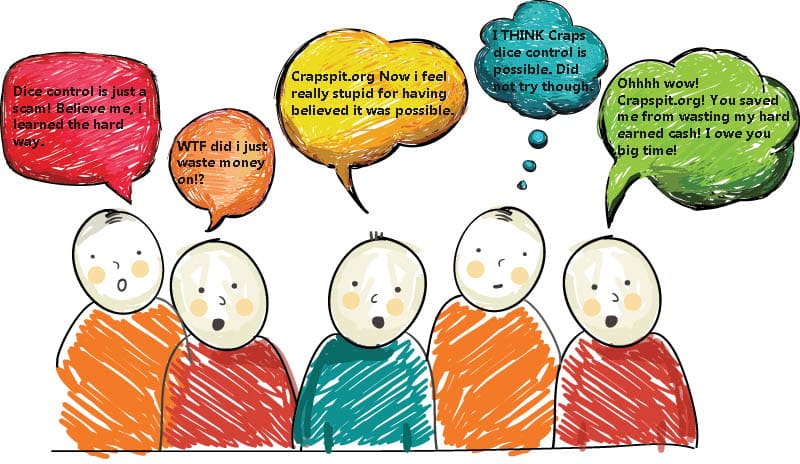
No publicly verified body of real-casino results currently establishes that a human shooter can sustain a player advantage with rule-compliant throws. Treat paid instruction and profit claims as unproven unless the seller supplies a preregistered method, a large complete dataset, and independent replication.
Dice setting is not the same as dice control
Dice setting means arranging the faces before a throw. A shooter can plainly do that when the crew allows a reasonable setup. Dice control is the much stronger claim that the orientation survives release, flight, table contact, and the back wall often enough to change the distribution of outcomes.
The fact that a deliberate toss is physically different from a careless toss does not prove a betting advantage. The relevant question is whether the final totals depart from fair-dice expectations by enough to overcome the house edge under actual game rules.
Why personal observation is weak evidence
- Selection: players tend to remember impressive hands and forget ordinary seven-outs.
- Small samples: normal variance can produce dramatic clusters of points and long hands.
- Changing technique: switching sets or targets after seeing results makes the hypothesis impossible to evaluate cleanly.
- Incomplete records: recording only successful practice sessions hides the denominator.
- Different conditions: a short home rig is not a full casino table with the same bounce, distance, and enforcement.
What a credible test would require
| Requirement | Why it matters |
|---|---|
| Define the claim before throwing | Choose the set, target statistic, stopping rule, and success threshold in advance. |
| Use rule-compliant conditions | Both dice must be thrown as the crew requires; invalid attempts cannot be silently removed. |
| Record every throw | Totals, die faces, no-roll calls, table, position, and conditions prevent cherry-picking. |
| Collect a large sample | A few hundred rolls can look persuasive while remaining normal variance. |
| Test an untouched sample | Training results and evaluation results should not be the same data. |
| Allow independent review | Others need the raw data and method to reproduce the calculation. |
What the 2025 statistical paper does—and does not—show
Mathematician Stewart N. Ethier’s 2025 paper, “Testing for dice control at craps”, develops methods for testing whether observed results fit proposed dice-control models and whether any effect would be large enough to create an advantage. That is useful progress because it separates “some detectable influence” from “enough influence to beat the game.”
The author also states an essential limitation: the paper contains no actual shooter data and takes no position on whether dice control works. A mathematical model of a possible effect is not evidence that a person has produced the effect.
The break-even claim must be bet-specific
“Fewer sevens” is not a complete betting strategy. Come-out 7 wins Pass, while a point-cycle 7 loses it. Place bets, Don’t bets, hardways, and bonus bets respond differently to changes in individual totals. A valid advantage claim must specify both the altered distribution and the exact bets used.
Long rolls do not prove control
Patricia DeMauro’s documented 154-roll hand is an extreme example of what random play can produce; there is no evidence that her result came from a controlled throw. Ethier’s calculation puts the probability of a fair-dice hand of at least 154 rolls at about 1 in 5.59 billion. Rare does not mean impossible, and the existence of an outlier does not identify its cause.
Practice for accuracy, not promised profit. Learning to keep dice on the table, reach the back wall, and avoid delaying the game can improve etiquette. Do not confuse that practical skill with proof that you changed the odds.
How to evaluate a dice-control seller
- Do they publish all results or only highlight winning hands?
- Is the sample large, dated, and collected under casino-equivalent conditions?
- Was the method fixed before the test?
- Can an independent statistician inspect the raw roll data?
- Are refunds, costs, and affiliate relationships clear?
- Do they promise reliable income or use urgency instead of evidence?
Continue with the gambler’s fallacy, distribution and variance, and the documented longest craps roll.