
Craps bet guide · Reviewed August 18, 2026
A Place bet wins when your selected 4, 5, 6, 8, 9, or 10 rolls before 7. It is a flexible standing bet: you can normally make, change, call off, or remove it between rolls. Place 6 and 8 carry the lowest standard house edge in the group at 1.52%.
Sam’s verdict
Place 6 and 8 have long been my preferred way to add controlled number action because the payout is close to true odds and the wager can be removed. That flexibility does not predict rolls or guarantee a session result. It lets you choose how much money remains exposed.
How a Place bet works
- Your selected number rolls first: the bet wins and commonly remains working unless you change it.
- 7 rolls first: the bet loses.
- Any other total rolls: nothing happens; the bet continues.
A Place bet is separate from the table point. You may place the point itself, although players with Pass Line plus Odds often already have that number covered. Place bets are commonly off on a new game’s come-out unless the player calls them working and the dealer confirms with an ON marker. Always check house procedure.
Payouts, correct multiples and house edge
| Place number | Standard profit payout | True odds | House edge | Useful wager multiple |
|---|---|---|---|---|
| 4 or 10 | 9 to 5 | 2 to 1 | 6.67% | $5 |
| 5 or 9 | 7 to 5 | 3 to 2 | 4.00% | $5 |
| 6 or 8 | 7 to 6 | 6 to 5 | 1.52% | $6 |
The house edge comes from the difference between the true odds and the casino payout. A $30 Place 6 win pays $35 rather than the $36 true-odds profit. The missing dollar across the probability of winning and losing produces an edge of about 1.52%.
| Wager | Calculation | Profit | Total if taken down |
|---|---|---|---|
| $20 Place 4 | $20 ÷ 5 × 9 | $36 | $56 |
| $10 Place 5 | $10 ÷ 5 × 7 | $14 | $24 |
| $18 Place 8 | $18 ÷ 6 × 7 | $21 | $39 |
| $30 Place 6 | $30 ÷ 6 × 7 | $35 | $65 |
A Place wager commonly remains working after a win, so only the profit is normally paid. The last column includes the original stake only if you also take the wager down.
Correct multiples matter: a crew may accept an improper amount and round the payoff under house procedure, but you should not assume how breakage will be handled. Ask for the nearest properly payable amount.
How to place the bet at a live table
- Wait until the dice are in the center and the dealer is ready.
- Get the dealer’s attention.
- Put the chips in the Come area or apron where that dealer prefers.
- State the number and amount clearly: “Eighteen dollars on the eight, please.”
- The dealer moves the chips into the correct number box and positions them to identify your table location.
Do not reach into the dealer’s working boxes or toss chips into established stacks. If the dealer asks you to place chips in a different pickup area, follow that instruction for subsequent bets.
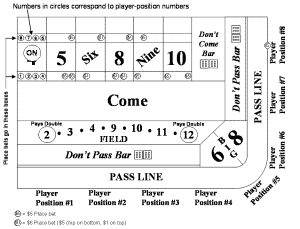
The diagram preserves an important live-table detail: chips that appear crowded are organized by player position. The dealer uses each chip’s location in the upper or lower Place-bet strip to distinguish ownership. Let the crew control those stacks.
Reading player positions in a crowded number box
The original CrapsPit diagram showed eight player positions around one end of the table. Positions nearest the stickperson map toward one side of each Place strip; positions nearest the base dealer map toward the other. A dealer can therefore track one player on 9 and 10, another on 6 and 8, and another on 5, 6, and 8 without labeling every stack.
That mapping also explains why a player should not “help” by moving chips. Shifting one stack a few inches can make it appear to belong to a neighboring position or convert its apparent meaning from Place to Buy, Lay, Come, or Don’t Come. If something looks wrong, point to your rail position and ask the dealer to verify the wager verbally.
When a number rolls, the dealer commonly settles contract/Come wagers and then Place wagers in a defined order, moving through player positions. Do not shout an instruction the instant the dice stop. Wait until the dealer reaches your stack and say “same bet,” “press to thirty,” “take down the five,” or another precise call.
Placing the point
Some layouts and crews allow a player to indicate a Place bet on the current point by centering chips on the back edge of the Pass Line. The old CrapsPit lesson correctly warned that a shifted stack can resemble a flat Pass wager or Pass Odds. The clearer method is to call the Place bet and have the dealer position it in the numbered box. House procedure controls.
Same bet, press, regress, off and down
| Call | What you are requesting |
|---|---|
| Same bet | Pay the profit and leave the original amount working. |
| Press | Increase the working wager, often using some or all of the profit. |
| Regress | Reduce the wager and return the difference. |
| Take it down | Remove the wager completely and return the chips. |
| Off | Leave the chips positioned but make them temporarily inactive. |
| On / working | Reactivate an off wager or request action on a come-out. |
After a win, wait until the dealer approaches your position, then state the instruction. Crews follow an organized payment sequence, but the exact order and default treatment of silence can vary. “Same bet, please” is clearer than assuming the dealer knows your intent.
Taking a wager down returns the chips to your rack. Calling it off leaves the wager located on the layout under an OFF marker so it can be reactivated without rebuilding the stack. An OFF marker may remain until you call it back on.
Inside, outside and across
| Call | Common meaning at a $5 base | Total |
|---|---|---|
| Inside | $5 each on 5 and 9; $6 each on 6 and 8 | $22 |
| Outside | $5 each on 4, 5, 9, and 10 | $20 |
| Across | $5 each on 4, 5, 9, 10; $6 each on 6 and 8 | $32 |
Point treatment can change the intended amount. If you already cover point 6 with Pass plus Odds, “$16 inside excluding the point” commonly means $5 on 5, $6 on 8, and $5 on 9. Do not rely on shorthand until you know the crew’s convention; naming the exact numbers is always valid.
What happens when the table point changes?
If the shooter makes the point, your Place bets normally stay positioned but are off for the next come-out. If a new point is a number you already placed, you can leave both exposures, take the Place bet down, or move it to another number. There is no universal requirement to avoid covering the point twice; it is a bankroll choice.
Worked table sequence
- The point is 10. You ask for $5 on 5, $6 on 6, $6 on 8, and $5 on 9: $22 inside.
- A 6 rolls. The $6 Place 6 wins $7. You call “same bet,” collect $7, and leave $6 working.
- Another 6 rolls. You call “press.” The dealer can add $6 to make the wager $12 and return the remaining $1.
- A 9 rolls. The $5 Place 9 wins $7 and stays at $5 after your same-bet call.
- The shooter makes point 10. Your Place bets stay on the layout but are normally off for the next come-out.
- The new point is 9. Because you also have a Pass Line wager on 9, you move the $5 Place 9 to 4.
- Your $12 Place 6 wins again for $14. You collect the profit and leave $12 working.
- A 7-out later collects all working Place bets. Earlier hits did not make the seven more or less likely.
Sam’s legacy cold/choppy/hot progression
This session-management method starts with two $6 Place bets on 6 and 8. Its stop and press choices control exposure, not the dice. The labels do not identify a predictive table condition; independent rolls do not become hot, cold, or due.
| Legacy label | Original operating rule | What it actually changes |
|---|---|---|
| Cold | Keep $6 on 6 and $6 on 8 until the first hit or six rolls; then call them off or take them down. | Limits the duration of exposure after one collected win or a six-roll window. |
| Choppy | If a win arrives within three rolls, restart the count; after three wins within those windows, press the next win. Stop after six rolls without a win. | Creates conditional stop and press rules based on recorded results. |
| Hot | Leave the 6 and 8 working for the roll, press every other win, add coverage after made points, then add/buy 4 and 10 after inside numbers are covered. | Raises total exposure as the roll continues. |
Taking money down can reduce what a later 7 removes. Pressing and expanding coverage can increase both potential payouts and the amount lost on 7. Neither approach changes the house edge of each individual Place wager.
What the legacy progression looks like in dollars
Start with $6 each on 6 and 8, so $12 is exposed. Under the old “cold” rule, a first hit pays $7. Calling both wagers down returns the $12 principal and locks the $7 profit. Leaving both up after that hit still exposes $12; one additional hit produces another $7, while 7 removes the $12. The stop rule changes how long the money remains exposed, not the next-roll probability.
Under the “choppy” rule, a hit inside three rolls restarts the short count. After three qualifying wins, the next win is used to press. If six rolls pass without either number, both bets come down. This is a recordkeeping system with clear triggers, which some players find easier than making an emotional decision after every roll.
Under the “hot” rule, repeated wins and made points expand the amount working. Pressing every other win can move a $6 wager to $12, while adding 5 and 9 increases total inside exposure from $12 to $22. Adding or buying 4 and 10 takes the base across exposure to $32 or more. The progression’s risk grows precisely when a long roll makes the player feel most confident.
Compare a collected hit with a press
Start with $6 on each of 6 and 8, or $12 at risk. If 6 rolls, its 7-to-6 payout earns $7 profit. A same-bet call puts $7 in your rack and leaves $12 working; a later 7 loses that $12, leaving the two-decision sequence down $5. Taking both bets down after the first hit returns the $12 stake as well and locks in the $7 profit.
If you instead use $6 of the $7 payout to press 6 to $12, you collect $1 and leave $18 exposed: $12 on 6 and $6 on 8. Another 6 earns $14 profit on the pressed wager, but a 7 before that hit removes $18. The larger payout is paired with a larger amount at risk; the earlier 6 does not make another 6 more likely.
Bankroll and exposure
House edge describes expected cost per resolved amount; it does not cap the size of a single loss. A $6 Place 6 has a favorable comparison to many other bets, but $32 across loses the full $32 when 7 arrives before another number pays. Presses can make the next seven-out larger than the profits already collected.
- Choose the maximum total you will allow across all Place numbers.
- Track money returned to the rack separately from chips still working.
- State press amounts explicitly; “press” can be interpreted differently by amount and house custom.
- Do not keep wagers working on a come-out merely because the previous game lasted a long time.
Place versus Buy
Buying a number pays true odds but charges commission. Buy 4 or 10 is often better than placing it when commission is charged only after a win. Place 6 or 8 is usually better than buying it. Commission timing and rounding can change the crossover, so use the dedicated Buy bet comparison.
Place-bet questions
Does a winning Place bet come down?
It commonly stays up and working while the profit is delivered. Call “take it down” if you want both the original wager and profit returned.
Can I place a number before a point exists?
Many tables accept the wager but treat it as off for the come-out unless you call it working. Dealers may prefer that new Place bets wait until a point is established.
Is Place 6 always better than Pass Line?
They are different sequences. Place 6 has a 1.52% edge on that standing wager; Pass Line has about 1.41% on the flat contract and can add true Odds. Place offers removal and number selection, while Pass includes come-out results.
Primary rule source
Beginner path · Lesson 5 of 8: Understand a standing Place bet
Check your understanding
A working $12 Place 6 wins. If you say “same bet,” what reaches your rack and what stays exposed?
Show the answer and explanation
$14 profit reaches your rack under the standard 7-to-6 payout. The original $12 remains on the layout. Taking it down would return that stake as well.
Explain the answer in your own words before continuing. Reading this topic does not require you to use the wager or visit a casino.

There is very little left for comments. Anyone following this and understand each suggestion, will be on their way to become a decent Craps Player. One point I would like to make that has not been explained, as far as the Place Bet NOT paying correct odds. I look at Place Bets as better than a Come Bet and even as good as a Pass Line Bet.
A, for example, $5 5 or 9 pays $7 for a $5 Place Bet. I break it down as a $1 flat bet for even money (the Pass Line wager) and $4 Odds, which are paid Correct Odds. The $1 flat bet earns $1, the $4 “odds” bet earns $6 for a total of $7 for the $5 wager. It is the SAME if you wagered $1 on the Pass Line and $4 Odds for a payout of $7. You do not have the Come Out loss on a 2,3 or 12, or a even money win with the 7 or 11, but that is the “COST” to be able to play 4X Odds at a, lets say, a 2X maximum Odds table at some Casinos.
The small reward for a Front Line winner 7 or 11, or a Craps loss 2, 3 or 12 I consider a wash.
Playing at a 2X Odds Craps Table… the Place Bet delivers a 4X Odds option and the flat bet portion is not a Contract bet and can be taken down at any time, unlike the Pass Line contract wager.
Thanks for the comment. Sorry, but no matter how you twist and turn the numbers, you can’t make them into something they’re not. Numbers and math are fact; they’re truth. The mathematical fact in this case is that the Don’t Pass and Pass with Odds bets have the lowest house advantage of all bets on the craps table. The Pass Line with single Odds has a house advantage of only 0.85% (that’s less than 1%). The Place bet on the 6 or 8 has a house advantage of 1.52%. The Place bet on the 5 or 9 has a house advantage of 4%. No amount of theorizing, rationalization, or manipulation of the numbers will ever change that fact. The Come bet is simply a Pass Line bet made after a point has been established. The mathematical fact is that if you play only the Pass Line with Odds (or Come with Odds) over a long period of time, you’ll lose about 9 cents (i.e., 8.5 cents rounded up) for every $10 you bet; and if you play only the Place 6 or 8 over a long period of time, you’ll lose about 15 cents for every $10 you bet; and if you play only the Place 5 or 9 over a long period of time, you’ll lose about 40 cents for every $10 you bet. For the 5 and 9, when your bet amount gets big enough such that the house allows it (i.e., usually $24), you should switch to a Buy bet to reduce the house advantage down to 1.96% when you pay the vig after a winning bet. That is, instead of Placing the 5 or 9 for $25, you should Buy the 5 or 9 for $24. (Refer to our other article that explains why this is true: https://www.crapspit.org/buy-5-9-instead-placing/ ) But even with a Buy bet on the 5 or 9, it still has a higher house advantage than the Pass (or Come) with Odds. Again, no matter how logical your complex breakdown might seem, the mathematical fact is that the Place bet will never be better than the Pass and Don’t Pass bets (or Come and Don’t Come) in terms of house advantage. Don’t feel bad, you’re certainly not the only person in the last 100 years who’s tried to analyze the numbers in the game of craps and come up with their own mathematical rationalization (i.e., trying to make something sound reasonable but just isn’t true). Trust and believe the math. Do not view Place bets as “better” than Come or Pass Line with Odds bets in terms of house advantage.
Editorial clarification, September 6, 2026: The Buy-bet percentage above needs its fee and denominator stated. A $24 Buy 5 or 9 with a $1 commission collected only on a win has an expected loss of $0.40 per decision, or 1.67% of the $24 base wager. If an exact, unrounded 5% commission ($1.20) is collected only on a win, the edge is 2.00% of the $24 base wager. The historical 1.96% figure does not match the $24-and-$1 example as written. Commission timing, rounding, eligible amount, and the chosen denominator must accompany any comparison.
Could you chart both side by side for an easier comparison and use $25 (5/9) & $30 (6/8) wagers on the Place Bet side, and… Buy Bets, paying a $1 vig after a winning bet?
Thank you- SevenOut
SevenOut, thank you for your follow-up comment, but we’re unsure of exactly what you’re asking us to chart. If you’re looking for a table of house advantages for Place Bets, Buy bets, and Pass Line with Odds bets at specific bet amounts, it’s an inconsequential comparison because the house advantages don’t change with the bet amounts.
For the 5 or 9 Place bet, it doesn’t matter whether you bet $5 or $25, the house advantage is still 4%. For the 6 or 8 Place bet, it doesn’t matter whether you bet $6 or $30, the house advantage is still 1.52%. For the Pass Line with single Odds, it doesn’t matter whether you bet $5 on the Pass Line with $5 Odds or bet $25 on the Pass Line with $25 Odds, the house advantage is still 0.85%. The only difference is, the more you bet, the more you should expect to lose over time based on the house advantages.
For example, for every $10 that you bet on the Place 5 or 9 over a long period of time, you’re going to lose 40 cents. That means, for example, if your total bet amount on the Place 5 or 9 over the long term is $100, you can expect a loss of $4.00 (4% of $100 = $4). If your total bet amount over the long term is $1,000, you can expect a loss of $40 (4% of $1,000 = $40). If your total bet amount over the long term is $10,000, you can expect a loss of $400 (4% of $10,000 = $400). Regardless of the bet amount for your individual Place 5 or 9 bets, you can expect to lose 4% of the total bet amount over the long term. Therefore, a table that compares house advantages for certain bet amounts (e.g., $25 and $30 wagers as stated in your follow-up response) is of little or no value.
We’ve already provided a table of house advantages in our other article entitled, Which Bets are Good and Which Bets are Bad? ( https://www.crapspit.org/good-bad-craps-bets/ ) That article also provides a detailed explanation, with the math, for calculating the house advantage using the basic Pass Line bet as an example. The table in that article gives you a quick-and-easy look at the house advantages for the most common craps bets, and even provides our opinion on whether a particular bet is “good,” “maybe,” or “bad” based on the house advantages. That’s all you need to know if you’re looking for the smartest bets based on house advantages. You can’t change those house advantages with any sort of rationalization, varying bet amounts, or complex betting schemes. If you’re not a math person and this concept is difficult to understand (which is okay because a lot of non-math people don’t fully comprehend it), you’ll just have to trust us that the house advantages don’t change based on your individual bet amounts. Craps is not an artsy game, it’s a mathematical game.
Unlike the world of art where individual preference affects a person’s perception, the world of craps is entirely mathematical and constant. For example, unless you change the rules or cheat, there’s no way to change the house advantage for a Place bet on the 5 or 9. Whether you bet $5, or $25, or $500, the house advantage for that bet 4%. If you don’t trust the house advantages in our table, then you’re encouraged to calculate them yourself using the process described in our other article. And if you don’t want to take the time to do the math yourself, you’re welcome to visit other reputable craps-related websites (the keyword is “reputable”), such as the “Wizard of Odds,” ( http://wizardofodds.com/games/craps/ ) which we believe is a trustworthy site that doesn’t feed you a load of crap about craps.
In summary, since we’re unsure of exactly what you’re asking in your follow-up response, we assume it’s a simple question, “What’s the house advantage for the Place bets and Buy bets on 5, 6, 8, and 9, and for the Pass Line with Odds?” The answer is provided in the table found in our other article, Which Bets are Good and Which Bets are Bad? https://www.crapspit.org/good-bad-craps-bets/
Editorial clarification, September 6, 2026: The fixed-ratio examples above scale as stated when payouts and charges scale proportionally and the wager uses clean units. Bet size can matter in actual comparisons when a minimum or rounded commission, payout breakage, or a house-specific threshold does not scale proportionally. Buy-bet comparisons therefore require the actual wager amount, commission timing, rounding, payout, and denominator. A universal percentage should not be applied across all amounts unless those rules are fixed.
Thank you. Understanding the math would discourage anyone considering walking into any Casino and playing any of the House Advantage loaded options. The buffets become the best deal in Las Vegas. And that is it. Maybe rooms and the great shows on the Strip.
I will keep reading through the website. IF Craps players depended on the statistical long term percentages, no one would care to play any Casino table game. I play for the random rolls outside of the statistical norm. I play the Pass Line with Odds and if it is an inside Pass Line point, the inside with Place Bets. I understand that the House gets a cut on most “winnings”. That is the cost of playing.
My System plays the short term for those rolls that do not conform to the mathematics and the 1,000,000 roll statistics. I am not a statistical player, but wagering on those rolls for the short term. Place Bets are my choice. Odds bets are maybe the best wager on the Pass Line, but I find my concept of the Place Bet the next best option for a Right Side bettor.
If I were to use John Scarne’s advice… Do Not Play any Casino Game with the regressive payouts to correct odds.
I am a hit and run, short game player. Take my wins or minimize my losses and leave the table. Mathematics and Statistics has no answer to how to win, only how the Casino charges you for each win and takes it all on a loss.
I am not a long term player. The mathematics and statistical percentages are not in my favor with any time at the table. It sure beats playing Lotto and Scratch Tickets… this we will agree upon. The House Advantage is my cost to cover overhead. This we probably will agree. The rest… it all up to when you quit.
I agree with your ideas, it seems to me all the talk about vigorish when it comes to craps is irrelevant in the time frame of a few hours. People talk about losing 10 cents for every dollar blah blah blah. The trick is to play numbers that have a high probability of showing up…like a 6 and not so much a 12…getting lucky and parlaying something quick before your bankroll disappears. What are your thoughts on pressing the field bet? Comes in streaks sometime…16 ways to win 20 to lose…triple pay on the 12.