3 Number Progression/Regression: Correct Cash Flow
Pass with Odds · Place 6 and 8 · Press once · Regress
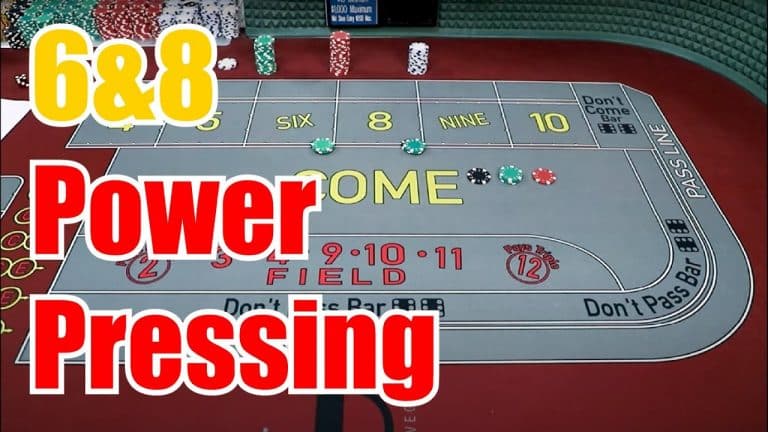
The 3 Number Progression/Regression combines a Pass Line point with Place 6 and 8. One Place hit presses both numbers; a second Place hit regresses them below the starting level. The contributor’s $5 example correctly locks an $8 cycle gain if the returned cash is not re-bet.
The accounting works; “after two rolls” does not
The plan requires two 6/8 hits, not merely two rolls. Ignoring neutral totals, two 6/8 hits before 7 occur with probability (10/16)² = 39.06%. A point win or come-out can also interrupt the stated layout.
$5 line-bet example
| Stage | Action | Rack cash | Still working |
|---|---|---|---|
| Point established | $5 Pass + $10 Odds + $12 each 6/8 | $0 | $39 |
| First 6/8 hit | Win $14; press both from $12 to $18 | $2 | $51 |
| Second 6/8 hit | Win $21; regress both from $18 to $6 | $47 total | $27 |
| 7 next with point 5 | All $27 working loses | $47 | +$8 cycle |
After the first hit, increasing both Place bets by $6 costs $12 of the $14 win. After the second, the $21 payout plus $24 removed in the regression adds $45 to the earlier $2 rack balance.
Scaled $10 line-bet example
The contributor’s doubled version starts with $10 Pass, $20 Odds, and $24 each on 6/8: $78. The first $28 win presses both to $36 and banks $4. The second $42 win plus a $36 regression to $18 each returns $78 more. Rack cash becomes $82 with $66 working, locking $4 if 7 follows.
Rules the original left open
- If the point is 6 or 8, decide whether that number is also placed.
- If the Pass point is made before two Place hits, decide whether to reset or keep the Place sequence through the come-out.
- Place bets are normally off on the come-out unless called working.
- Point-specific Odds payouts change the line portion, although Odds remains zero edge.
- Pressing after the regression can give the locked $8 or $4 back.
What “three numbers” really means
The three targets are the Pass point, 6, and 8. They do not all have the same payout or loss condition. A point hit wins the line contract; 6/8 hits pay the Place bets; 7 loses all three once a point exists. Keep those components separate rather than calling the complete layout free after regression.
Review Pass and Odds, the 6/8 regression with 4/10, and Place-bet payouts.
Write the reset rule before the first hit
Record four state items before using the progression: the Pass point, whether a Place bet duplicates point 6 or 8, whether the Place bets work on the come-out, and what happens when the line point wins before two Place hits. Those choices determine whether the next roll continues the same cycle or starts a new one.
A conservative tracking rule is: pause the progression whenever the Pass contract resolves, call the Place bets off for the next come-out, and resume only after recording the new point and current Place levels. If the new point is 6 or 8, decide whether to remove the duplicate Place wager before action reopens.
The reset rule does not improve expected value. It prevents an old press level, a new Pass contract, and a changed point from being treated as one continuous sequence after the table state has already changed.