
Craps bet guide · Reviewed September 4, 2026
A Come bet is essentially a personal Pass Line sequence that begins after the table already has a point. On its first roll, 7 or 11 wins, 2, 3, or 12 loses, and 4, 5, 6, 8, 9, or 10 becomes your Come number. After that, your number must repeat before 7.
Sam’s verdict
The Come bet looks complicated because your private sequence runs inside the table’s larger Pass Line game. Learn the two stages separately and it becomes straightforward. The flat Come has the same roughly 1.41% house edge as Pass Line. Come Odds pay true odds, but they increase the dollars exposed to the next decisive roll.
Follow the chips
Two points can exist at the same time
Your Pass Line
- The shooter already established 5.
- The next roll is 10. Pass Line waits.
- A later 5 wins the Pass Line.
Your new Come wager
- Place it in the Come box while the table point is 5.
- The next roll is 10. The dealer moves this wager to 10.
- It needs 10 before 7, even after the table makes 5.
Come bet rules in two stages
| Stage | Roll | Result |
|---|---|---|
| First roll after placing Come | 7 or 11 | Flat Come wins 1 to 1 |
| First roll | 2, 3, or 12 | Flat Come loses |
| First roll | 4, 5, 6, 8, 9, or 10 | That number becomes your Come number |
| After a Come number exists | Your Come number | Flat Come wins 1 to 1; working Odds also win |
| After a Come number exists | 7 | Flat Come loses; working Odds lose |
| After a Come number exists | Any other total | No decision |
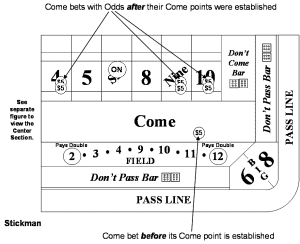
The table’s Pass Line point and your Come number can be different. If the table point is 5 and your Come number is 10, a 10 wins your Come bet while a 5 makes the table point. Your established Come 10 can remain after that Pass Line game ends.
How to make the flat Come bet
- Wait until the table point is established and bets are open.
- Place the flat wager in the Come box nearest your position.
- The next roll is that wager’s private come-out roll.
- If a box number appears, the dealer moves the flat chip to that number and positions it to identify you.
- Once it travels, let the dealer handle the wager.
You can place additional Come bets on later rolls. It is common to have established Come wagers on several numbers while another flat bet waits in the Come box.
Taking Odds on a Come number
After the flat Come travels, you can add an Odds wager. Put the chips where your dealer directs and state the amount clearly. The dealer places the Odds with the flat bet in a configuration that distinguishes the two portions.
| Come number | True-Odds profit payout | Example |
|---|---|---|
| 4 or 10 | 2 to 1 | $5 wins $10 |
| 5 or 9 | 3 to 2 | $6 wins $9 |
| 6 or 8 | 6 to 5 | $5 wins $6 |
The Odds portion has no built-in house edge at the true-odds payoff. That does not make it risk-free. It increases how many dollars are exposed when your Come number or 7 appears.
Maximum Odds and payable increments are house rules. See the craps table-limits guide before assuming a particular multiple.
What happens on a new come-out roll?
This is the procedure that causes the most confusion.
When the shooter makes the table point, established flat Come bets normally remain working into the next game. Come Odds are commonly off on the new come-out unless the player calls them working and the dealer accepts the instruction.
| New come-out result | Established flat Come | Come Odds normally off | Come Odds called working |
|---|---|---|---|
| 7 | Loses | Returned/no action | Loses |
| Your established Come number | Wins | No action on the Odds | Wins at true odds |
| Other total | No decision | No decision | No decision |
Important: “Come Odds off” does not mean the flat Come is off. The flat wager and its Odds are separate components and can have different working status.
House procedures can vary, so confirm the status with the dealer rather than relying on memory from another casino.
“Off and on” when the same number repeats
Suppose you already have a $5 Come bet on 6 and place another $5 in the Come box. If 6 rolls, the established Come 6 wins, while the new flat Come would also travel to 6.
Instead of removing one $5 chip and replacing it with another identical $5 chip, the dealer may leave the existing flat chip in position and simply pay the win. That bookkeeping shortcut is called off and on.
If the established bet had Odds, those Odds are settled separately. Watch where the payoff is placed, because chips left in the Come box can be interpreted as a new bet.
Audit an off-and-on payment with Odds
Suppose $5 Come is already on 6 with $10 working Odds, and another $5 flat Come waits in the Come box. The total on the layout before the roll is $20. If 6 appears, the old flat Come wins $5 and its $10 Odds win $12 at 6 to 5. The old position has earned $17 profit and its $15 stake is returned, for $32 from that settlement. The new $5 Come moves to 6 and remains exposed.
The dealer may leave the old flat chip in the 6 box and exchange chips instead of visibly moving both $5 chips. The arithmetic is the same: $17 profit, $15 returned from the old position, and $5 still working in the new one. If the old Odds were off on a come-out, they would not win on that roll; confirm working status before applying this example.
A complete worked sequence
- The table point is 10. You place a $5 Come bet.
- An 11 rolls. Your Come wins $5 because this was its first roll.
- You leave another $5 in Come. A 5 rolls, so the dealer moves that flat wager to Come 5.
- You add $6 Odds to Come 5. A 3 and then an 8 roll; neither affects it.
- The shooter makes the table point 10. Come 5 remains, but its Odds are normally off for the next come-out.
- The new come-out is 7. The $5 flat Come loses; the off $6 Odds are returned.
- Later, with table point 6, a new $5 Come travels to 8 and receives $5 Odds.
- An 8 appears before 7. The flat bet wins $5 and the $5 Odds win $6.
The example shows why the Come bet must be tracked as its own sequence. A roll that ends one Pass Line game may leave an established Come wager alive.
Tracking several Come bets at once
Suppose the table point is 6. You have:
- $5 Come on 4 with $10 Odds,
- $5 Come on 9 with $6 Odds,
- another $5 flat chip waiting in the Come box.
One roll can affect those wagers differently:
- 4 wins the established Come 4 and its working Odds.
- 9 wins the established Come 9 and its working Odds.
- 7 wins the new flat chip still in Come but simultaneously loses the established Come 4 and Come 9.
- 2, 3, or 12 loses only the new flat chip; established Come numbers remain unresolved.
- 6 makes the table’s Pass Line point but does not settle Come 4 or Come 9.
This is the moment Come betting feels counterintuitive. Track each chip by location and stage, not by whether the table is cheering.
Come bet mathematics
| Component | House edge | What it means |
|---|---|---|
| Flat Come | About 1.41% | Long-run expected loss per resolved flat amount |
| Come Odds | 0% on that component | True-odds payoff for number-versus-7 probability |
| Flat + Odds combined | Depends on Odds amount | More Odds lowers the weighted edge percentage but increases dollars exposed |
The flat Come wins 244 times per 495 resolved decisions and loses 251. That produces an expected loss of 7 units per 495 resolved units, or about 1.41%.
Moving the Pass Line sequence into the middle of a game does not change the probabilities.
If you are deciding whether to use Come bets instead of number bets, compare our Place Bet vs. Come Bet guide as well as the Pass Line guide. You can also rehearse the mechanics in the free craps game.
Can a Come bet be removed?
Once a flat Come bet has established a number, it is generally treated as a contract wager and cannot simply be taken down. The Odds portion is separate and can normally be added, reduced, removed, or called working/off between rolls within the table’s rules.
Do not reach into the number box yourself. Ask the dealer.
Common Come-bet mistakes
- Treating the table point as your Come number. Your Come number is the first box number rolled after you place that specific Come bet.
- Trying to put Odds on before the flat Come travels. There is no Come number yet.
- Assuming the flat and Odds share the same come-out status. The flat normally works; the Odds commonly do not.
- Missing an off-and-on payoff. Watch whether the dealer left a replacement flat wager in place.
- Forgetting that several Come bets can be at different stages at once. A 7 can win the new flat Come while losing established Come numbers.
- Reaching into dealer-positioned chips. Let the crew move and settle traveled wagers.

if you have several come bets working and the point is made before the next roll can you say off on the come bets or do you have to have them working
Yes, the dealer will place the small black off button on your chips if so requested until you say turn them back on, so don’t forget !
Suppose you have a come bet and the thrower establishes it as, say, six. So, the dealer moves your chip to the six and that’s your flat come bet.
Now, you want to make another come bet and also put odds on your existing come bet.
What order do you do that? Odds first?
Let’s say you make a come bet and the next roll is an 11, you win. You collect your winnings, at that point are you able to remove your original come bet from the table? Or is it a contract bet the second it hits the table like a pass line bet?
Andrew, thanks for your question. In that specific scenario, you are, indeed, allowed to pick up the Flat Come bet. An 11 is a natural on the come-out roll for the Come bet (and Pass bet), and a natural ends the game. While the stickman still controls the dice (i.e., before he pushes them to the shooter), a new game has not yet started. So, your Flat Come bet can be removed at this time. Keep in mind that the dealer will leave your chip in the Come box and won’t ask you if you want to remove it. If you want to remove it, you must remove it yourself before the stickman pushes the dice to the shooter. This holds true for the Pass bet, too. Suppose the current game ends and the stickman controls the dice waiting for players to make their bets. You drop a chip on the Pass line. The shooter then rolls an 11 on the come-out. An 11 is a natural and ends the game. The dealer pays off your Flat Pass bet. You pick up your winnings and leave your Flat bet on the Pass line. Then, your wife approaches the table yelling at you for being late for your dinner reservation. A new game is about to start (i.e., a point has not been established) and the stickman still has the dice. Before the stickman pushes the dice, you can remove your Flat Pass bet and run with your wife to the restaurant. Good luck and have fun at the tables!