
Craps bet guide · Reviewed August 18, 2026
The Don’t Pass bet loses to 7 or 11 on the come-out, wins on 2 or 3, and normally pushes on 12. If a point is established, it wins when 7 arrives before that point. Its standard bar-12 house edge is about 1.36%.
Sam’s verdict
Don’t Pass is mathematically respectable and slightly lower-edge than Pass Line, but its chip handling and lay-Odds amounts are less intuitive. I recommend learning the flat wager first, then adding Odds only when you can state both the amount laid and the amount it wins.
Come-out rules
Place the flat wager yourself in the Don’t Pass area—traditionally called the back line—before the shooter releases the come-out roll. Once a point exists, you cannot start a new Don’t Pass flat bet for that game.
| Come-out total | Standard bar-12 result | What happens next |
|---|---|---|
| 7 or 11 | Lose | Game ends |
| 2 or 3 | Win 1 to 1 | Game ends |
| 12 | Push; wager is barred | Game ends and flat wager remains/returns under procedure |
| 4, 5, 6, 8, 9, or 10 | Point established | 7 must roll before the point |
On a bar-2 layout, 2 pushes and 12 wins instead; the probability is identical because each has one dice combination. A bar-3 rule makes 3 the push while 2 and 12 win. That uncommon version produces a much higher edge—roughly 4.4% per resolved wager—so read the actual layout.
After a point is established
| Next decisive result | Flat Don’t Pass | Lay Odds if present |
|---|---|---|
| 7 before point | Wins 1 to 1 | Wins at true odds |
| Point before 7 | Loses | Loses |
| Any other total | No decision | No decision |
After the point, 7 has more combinations than any one point. That conditional position favors the Don’t bettor, but the complete flat wager still has a house edge because the come-out disadvantages came first.
Conditional chances after each point
| Point | 7 combinations | Point combinations | Don’t Pass chance of winning after point |
|---|---|---|---|
| 4 or 10 | 6 | 3 | 6/9 = 66.67% |
| 5 or 9 | 6 | 4 | 6/10 = 60.00% |
| 6 or 8 | 6 | 5 | 6/11 = 54.55% |
These percentages apply only after the flat wager survived the come-out and a point was established. Quoting 66.67% for point 4 without including the come-out stage makes the complete Don’t Pass bet look better than it is.
You may remove or reduce the flat bet after the point, but generally may not replace or increase it. Removing it surrenders the favorable conditional position you already paid for by surviving the come-out. Rules and crew procedure should still be confirmed locally.
Don’t Pass house edge
| Component | House edge | Meaning |
|---|---|---|
| Flat Don’t Pass, bar 12 or bar 2 | About 1.36% | Long-run expected loss per initial flat wager, with pushes included |
| Lay Odds | 0% on that component | True-odds payoff with no commission |
| Combined flat plus Odds | Depends on Odds amount | Lower weighted percentage, but more dollars at risk |
The conventional 1.36% figure includes every initial wager in the denominator, including a bar-12 push. If pushes are removed and only resolved decisions are counted, the edge is 27/1,925, or about 1.40%. The expected loss has not changed; only the denominator has.
Laying Odds
After a point exists, you may add a separate Odds wager against it. Because 7 is more likely than the point, you lay the larger amount to win the smaller amount. Unlike a standalone Lay bet, Don’t Pass Odds carries no commission.
| Point | Amount laid to win | Example |
|---|---|---|
| 4 or 10 | 2 to 1 | Lay $20 to win $10 |
| 5 or 9 | 3 to 2 | Lay $15 to win $10 |
| 6 or 8 | 6 to 5 | Lay $12 to win $10 |
Use correct multiples to avoid rounded payoffs. Higher-denomination chips normally go at the bottom of a mixed stack. Maximum Don’t Odds may be defined by the amount you are allowed to win, rather than the larger amount you physically lay. Review the table-limits guide and ask the crew to state “lay X to win Y.”
Understanding maximum Don’t Odds
A placard advertising “3x-4x-5x Odds” may cap the win relative to the flat wager. With a $5 flat Don’t Pass, a common equal-lay implementation allows $30 laid on any point:
| Point | Amount laid | Odds profit | Profit as multiple of $5 flat |
|---|---|---|---|
| 4 or 10 | $30 | $15 | 3x |
| 5 or 9 | $30 | $20 | 4x |
| 6 or 8 | $30 | $25 | 5x |
Other tables describe limits differently. A “10x” rule may refer to maximum win rather than the physical lay, and pushed amounts can be restricted by the table maximum or payout cap. Ask for the maximum lay and maximum win on the specific point.
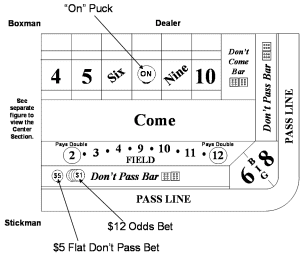
Heeling and bridging the Odds chips
Traditional layouts use two physical arrangements to distinguish Don’t Pass Odds from the flat wager and nearby chips. These are chip-handling conventions, not mathematical requirements, and not every crew uses the terms identically.
Bridging
When the Odds profit equals the flat-bet profit, a traditional bridge places an equal portion beside the flat wager and uses the remaining chips to straddle the stacks. Example: a $10 flat Don’t Pass with point 6 lays $12 to win $10. Ten dollars can sit beside the flat bet while the extra $2 bridges the two.
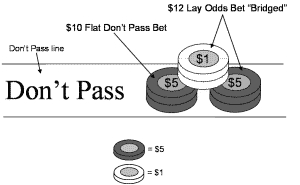
Heeling
When the Odds profit differs from the flat amount, the Odds stack may be heeled: the stack sits adjacent to the flat bet with upper chips offset so it visibly leans. Example: with a $5 flat bet and point 6, laying $24 wins $20. The separate, offset stack tells the crew it is Odds.

If you do not know the local arrangement, do not improvise. Put the chips where directed and say the intended win: “I want to lay twenty to win ten behind my Don’t.”
Worked game sequence
- You place $5 on Don’t Pass before the come-out.
- The shooter rolls 12. On a bar-12 layout, the wager pushes and remains available for the next come-out.
- The next come-out is 4, establishing the point.
- You lay $20 Odds to win $10. You now risk $25 total: $5 flat plus $20 Odds.
- A 10 and 9 roll. Neither decides either wager.
- A 7 rolls before 4. The flat bet wins $5 and the Odds wins $10; both original wagers are returned.
- On a later game, you place another $5 Don’t Pass and point 6 is established.
- You lay $12 to win $10. If 6 arrives before 7, both the $5 flat and $12 Odds lose.
The previous 7-out does not make another 7 more likely, and a series of points does not make the table “hot.” The sequence illustrates settlement, not prediction.
A mixed Pass-to-Don’t session example
A player may choose Pass on one game and Don’t Pass on another, but recent results do not justify the switch mathematically. Suppose a $5 Pass Line loses after point 5 and the player then moves to $5 Don’t Pass. Come-out 12 pushes, the next come-out 7 loses, and the following come-out establishes point 4.
At point 4 the player lays $50 Odds to win $25. A roll of 10 does nothing; a later 7 wins $5 on the flat and $25 on the Odds. The $30 profit does not demonstrate that the dice “turned cold.” It reflects one completed Don’t Pass sequence whose possible loss was $55 after the Odds went up.
The original article’s extended casino story usefully showed that the same shooter keeps the dice after come-out craps and that 12 can push before a later decision. Those procedural facts remain; the claims that table temperature or a player’s gut can forecast seven have been removed.
Table etiquette for Don’t bettors
Don’t Pass is a normal wager. Other players’ preferences do not change the dice, and your bet does not cause their loss. At many tables, Don’t bettors collect wins without loudly celebrating a seven-out because most nearby Pass players just lost. That is courtesy, not a rule and not an admission that the bet is improper.
Don’t Pass versus Pass Line
| Feature | Don’t Pass | Pass Line |
|---|---|---|
| Standard flat edge | About 1.36% | About 1.41% |
| Come-out 7/11 | Lose | Win |
| Come-out 2/3 | Win | Lose |
| Come-out 12 | Usually push | Lose |
| After point | 7 before point wins | Point before 7 wins |
| Odds direction | Lay more to win less | Take less to win more |
Read the complete Pass Line guide for the other side and use the free practice game to rehearse the come-out and point stages without money.
Don’t Pass questions
Can I make Don’t Pass after the point?
No. You must place the flat wager before the come-out. A standalone Lay bet is the direct way to bet 7 before a chosen number after a point already exists, but it charges commission.
Can I add to my flat Don’t Pass after the point?
Generally no. You may add separate lay Odds within the table limit, but the flat contract cannot be increased after it enters the favorable point stage.
Does Don’t Pass win whenever 7 rolls?
No. Come-out 7 loses. Seven wins only after a point has been established.
Does removing the flat bet improve the session?
Removal reduces immediate exposure but gives up a favorable conditional wager. It can be a bankroll decision, but it is not a mathematical improvement to that already-established contract.

On your 8:3 odds, how come it is not 8:4 with a roll of a twelve being the fourth way to win on the “don’t” side?
Hi Nick, thank you for your post.
The answer to your question is contained in the above article “The Don’t Pass Bet in Craps.” Without reiterating everything already stated in the article, let’s summarize it.
Near the beginning of the article, the four outcomes of a Don’t Pass come-out roll are defined.
Look at the third outcome listed. On most tables, there’s a “Bar 12” for the Don’t Pass (rarely does a casino have a “Bar 2” instead of “Bar 12”). If you bet the Don’t Pass and the shooter rolls a 12 on the come-out, then it’s a tie, so the number 12 is effectively eliminated as a win-lose option for the Don’t Pass on the come-out roll (i.e., it’s like a non-roll; it’s meaningless in terms of a win-lose decision). Continuing down the article, we see that the term “Bar 12” is defined so you know exactly what it means. And then a little further down the article, we talk about the Don’t Pass odds on the come-out. Remember, the 12 is a tie for the Don’t Pass on tables with “Bar 12,” so that means you win with a 2 or 3 on the come-out. There are two ways to make a 3 and one way to make a 2, which equals three ways to win on the come-out. Comparing that to the six ways to lose for the 7, and 2 ways to lose for the 11 (i.e., a total of eight ways to lose on the come-out), you get the odds of 3:8 (or 8:3 depending on your perspective). We suggest that you go back read the article again for clarification.
Don’t feel bad because you missed it the first time. We all go through the growing pains of learning the intricacies of the game, so don’t give up thinking it’s too much trouble or too difficult to learn! Once you get the hang of it and play a few times, you’ll understand what we mean when we say craps is the most fun and exciting game in the casino.