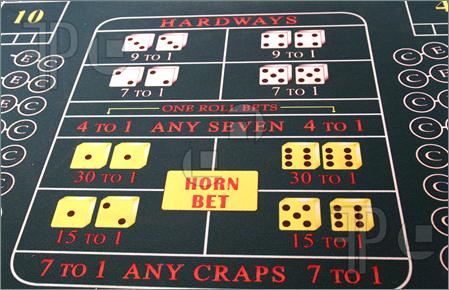
$20 Horn Bet Payout: What You Win When 12 Rolls
Horn payout · $20 example · 12 rolls
On a standard $20 Horn bet, $5 is placed on each of 2, 3, 11, and 12. If 12 rolls and the table pays 30 to 1, the winning $5 component earns $150 while the other three $5 components lose. Net profit: $135. Total chips returned: $155.
The answer in one table
| Total Horn wager | $20 |
|---|---|
| Amount on 12 | $5 |
| Profit on 12 at 30 to 1 | $150 |
| Loss on 2, 3, and 11 | −$15 |
| Net profit | $135 |
| Total returned including the winning $5 stake | $155 |
Why three parts lose
The Horn is not one wager with one payout. It is four simultaneous one-roll bets:
| Horn number | Share of a $20 Horn | Standard payout | Result when 12 rolls |
|---|---|---|---|
| 2 | $5 | 30 to 1 | Loses $5 |
| 3 | $5 | 15 to 1 | Loses $5 |
| 11 | $5 | 15 to 1 | Loses $5 |
| 12 | $5 | 30 to 1 | Wins $150 profit; $5 stake returned |
That is why subtracting the full $20 from $150 is wrong: the $150 figure is already profit on the winning $5 component. Only the other $15 loses. $150 minus $15 equals $135 net profit.
Profit versus total return
Casino payoffs are easy to misread because 30 to 1 describes profit, while 31 for 1 describes the total returned including the winning stake. On the $5 bet on 12:
- 30 to 1: $5 × 30 = $150 profit, plus the $5 stake;
- 31 for 1: $5 × 31 = $155 total return.
Both expressions describe the same standard payoff. Check the layout because some tables use different proposition paytables.
What if 3 or 11 rolls?
A $5 component on 3 or 11 wins $75 profit at 15 to 1. The other three $5 bets lose $15, producing $60 net profit and $80 total chips returned.
| Winning Horn result | Net profit on $20 Horn | Total returned |
|---|---|---|
| 2 or 12 at 30 to 1 | $135 | $155 |
| 3 or 11 at 15 to 1 | $60 | $80 |
| Any other total | −$20 | $0 |
Why the standard Horn edge is 12.5%
There are six winning combinations: one way each to roll 2 and 12, plus two ways each to roll 3 and 11. Thirty of the 36 combinations lose all four units. On a four-unit Horn:
[(2 × 27) + (4 × 12) − (30 × 4)] ÷ 36 = −0.5 unit
The expected loss is 0.5 unit on 4 units wagered, or 12.5%. A recent run of Horn numbers does not improve the next roll’s probability.
Use multiples of four. A standard Horn divides equally among four numbers. A non-multiple requires a Horn High instruction or a house-specific split.
See the full Horn and Whirl guide for Horn High, Whirl, payout variations, and house edges.