Table anatomy · Layout zones · Equipment and crew
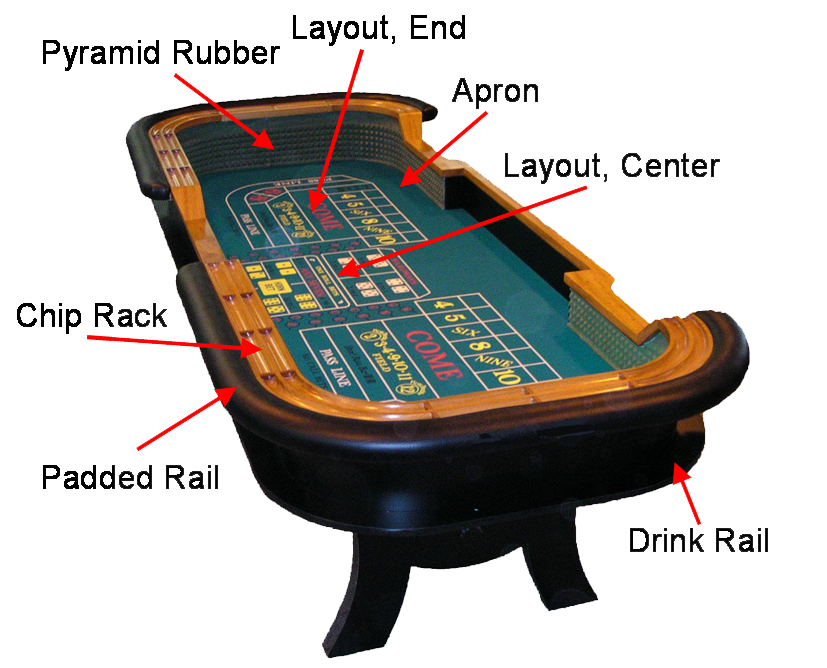
A casino craps table is a long, high-sided table built around a mirrored betting layout. The repeated end sections let players reach common bets, while the center section, equipment, and crew allow one roll to settle many wagers at once.
First visit? Ignore the center of the layout at first. Find the Pass Line in front of you, watch the ON/OFF puck, and learn one complete game cycle before adding other bets.
Craps table parts at a glance
| Part | What it is | Why it matters to a player |
|---|---|---|
| Table bed or tub | The enclosed playing surface | Holds the layout, chips, dice, and working game |
| Layout | The printed betting surface | Shows where authorized wagers are placed |
| Padded rail | Cushioned top edge | Defines the player boundary; never set bets on it |
| Chip rack | Grooved tray around the player rail | Keeps each player’s chips separated and visible |
| Back wall rubber | Textured rubber at each short end | Both dice are normally required to reach and strike it |
| Mirror | Long interior mirror opposite the dealers | Improves the crew’s view of hands, chips, and dice |
| Drop slot and box | Secured cash opening and container | Moves exchanged currency out of the live table area |
| Dice bowl or cup | Holder for dice not in play | Keeps spare dice under crew control |
| Stick | Long hooked table tool | Lets the stickperson move dice without reaching through bets |
| ON/OFF puck | Two-sided point marker | Shows whether a point exists and which number it is |
| Lammers or buttons | Small labeled markers | Identify bet status such as BUY, LAY, ON, or OFF |
The table bed, rail, and player positions
Traditional full-size tables are commonly described by length—often 8, 10, 12, or 14 feet—but there is no single universal casino size. Capacity depends on the table, crew, local rules, and how the casino numbers positions. Mini-craps, crapless craps, stadium, hybrid, and electronic versions can look very different.
The padded rail runs around the player side of the tub. Inside or immediately beside it are grooved chip racks, usually divided by position. Keep chips in the section directly in front of you and separate denominations so you can count them without disturbing the game. Some tables have an exterior drink shelf below the rail; use it only where permitted and never hold a drink above the layout.
How the craps layout is organized
A standard layout has two similar end sections and one shared center section. The duplicate ends are not separate games. They let players on both halves of a long table reach common wagers while the same dice result applies to everyone.
End sections
The two ends normally contain Pass Line, Don’t Pass, Come, Don’t Come, Field, and the numbered boxes used for Place, Buy, Lay, Come, and Don’t Come wagers. These bets are handled by the base dealer assigned to that half of the table.
Center section
The center normally holds proposition wagers such as hardways, Any 7, Any Craps, Horn numbers, and table-specific bonus bets. Players call these wagers to the stickperson or dealer rather than reaching into the center. Many center bets have much higher house edges than the line bets, so the most visually prominent area is not necessarily the best mathematical value.
See the separate craps table layout guide for a bet-by-bet map, or compare the numbers in the craps payout table.
Back wall, rubber pyramids, and mirrors
The short walls at both ends contain textured rubber, often called pyramids or diamond rubber. A standard legal throw sends both dice to the opposite end, where they strike this surface after landing on the felt. The irregular bounce discourages sliding and makes manipulation harder.
A long mirror is commonly mounted inside the wall opposite the dealers. It is not decoration: it improves sightlines across a crowded layout and helps the crew and surveillance observe hands, dice, and chips. Do not aim at it or strike it deliberately.
Cash handling: drop slot, drop box, and paddle
When a player buys chips with cash, the currency is spread on the layout so the amount is visible, then exchanged for chips. The cash is pushed through a narrow drop slot with a clear paddle into a locked box beneath the table. A separate secured box may be used for tips depending on local requirements.
Never try to place cash directly into a dealer’s hand. Put it flat on the layout between rolls, state the denomination you want if necessary, and wait for the dealer to complete the exchange.
Dice bowl, stick, puck, and betting markers
The stickperson controls the dice. Spare dice remain in a bowl or cup; the two active dice move to the shooter with the stick. At a new shooter’s first roll, several dice may be offered so the shooter can select two. The rest return to the bowl.
The large ON/OFF puck tracks the Pass Line game cycle. Black OFF means no point is established. When the come-out roll establishes 4, 5, 6, 8, 9, or 10, the dealer turns the puck to white ON and places it above that number. When the point repeats or 7 appears, the puck returns to OFF.
Smaller markers—often called lammers or buttons—help the crew label special conditions. BUY and LAY identify how a number bet should be paid; ON and OFF can show whether a wager works on the next roll. Marker colors and wording vary, so ask the dealer instead of guessing.
Where the crew stands
| Position | Typical location | Main role |
|---|---|---|
| Stickperson | Center, opposite the box side | Controls dice, calls rolls, and handles center action |
| Base dealers | One on each side of the box position | Book, pay, and collect wagers on their half |
| Boxperson | Center on the dealer side, when staffed | Supervises procedure, chips, dice, and disputed calls |
| Floor supervisor | Outside the table | Oversees multiple games and resolves escalated issues |
Some modern casinos operate without a seated boxperson or combine duties differently. Electronic and hybrid games may replace several crew functions with terminals. The relevant lesson for a player is simple: address the dealer responsible for your half of the layout and follow the stickperson when the issue concerns the dice.
Your first 60 seconds at a live table
- Read the posted table minimum, maximum, and Odds limit before buying in.
- Wait for the dice to be in the center, then place cash flat on the layout.
- Put received chips in the rack directly in front of you.
- Find the ON/OFF puck. If it is OFF, the next roll should be a come-out roll.
- For a first Pass Line wager, wait for a come-out with the puck OFF and confirm betting is open. If a point is already ON, watch that game finish before beginning your first line contract.
- Keep hands, drinks, and phones out of the table once the shooter has the dice.
Traditional, mini, bubble, and hybrid tables
A traditional table uses live dice and a full crew. Mini-craps shortens the table and may reduce staffing. Bubble craps uses enclosed physical dice with individual betting terminals. Stadium and hybrid formats combine a shared live or mechanical result with electronic betting stations. The underlying point cycle is recognizable, but paytables, bet availability, speed, and minimums can differ materially.
Read the separate bubble craps guide before assuming an electronic screen pays every wager like a live table.
Read the puck and each bet marker separately
Suppose the point is 5, a $10 Pass Line is unresolved and a $12 Place 6 is working. A 5 wins the Pass contract and sends the puck to OFF, but it does not win or lose the Place 6. The number wager can remain on the layout for the next come-out and commonly defaults to off unless called working. Confirm its status with the crew.
If the next roll is 7, a newly booked Pass Line wins while an off Place 6 neither wins nor loses. A Place 6 explicitly called working instead loses its $12 on that same 7. This is why the puck alone cannot show every chip’s exposure. Before the dice move, ask your base dealer which removable bets remain working, then compare the layout map with the actual markers.